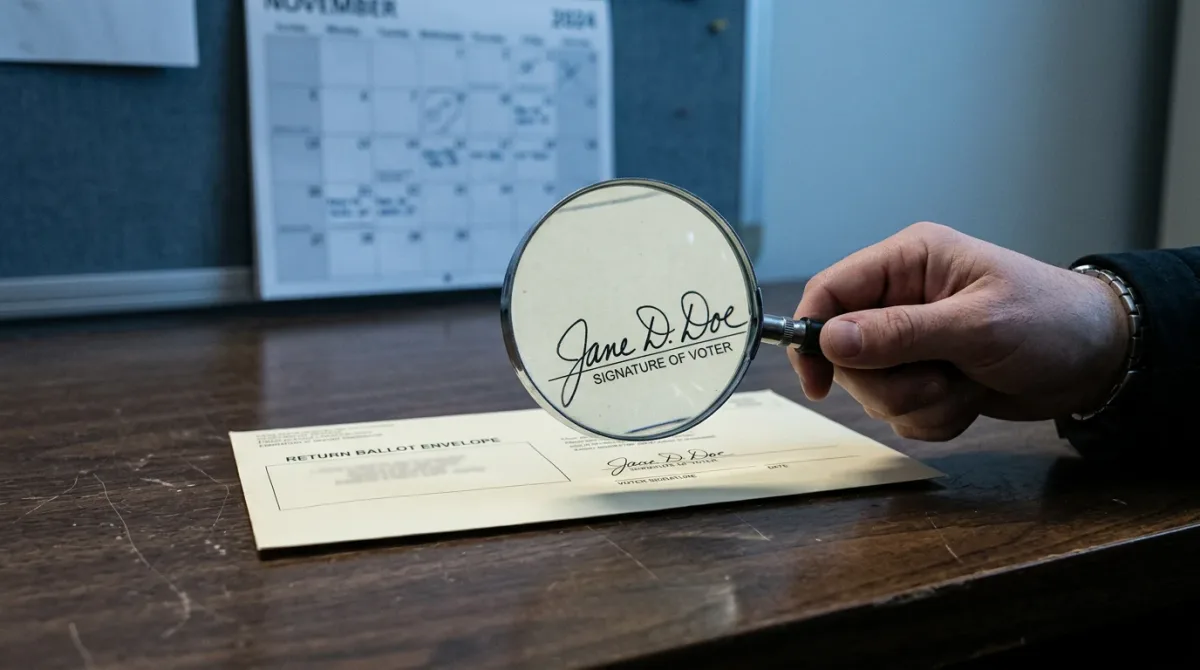
Ballot curing is the process that lets a voter fix a mail ballot flagged for a signature problem — missing, mismatched, or otherwise questioned — before the count is final, typically through a signed affidavit returned within a set post-election window. Roughly nineteen states notify voters when such a discrepancy is found and give them a chance to fix it before their ballot is rejected for good.
The safeguard exists because signature review is the last gate a mail ballot passes through before it's counted — and it's a human judgment call, not a machine certainty. Curing is the mechanism that keeps a single reviewer's read of a signature from being the final word, according to the agency's guidance for election officials.
What actually happens when a signature is checked?
Per the U.S. Election Assistance Commission's process guidance, offices that verify signatures use a tiered review rather than a single pass. In Tier 1, software or a first human reviewer looks for a near-perfect match between the signature on the ballot return envelope and the signature on file from voter registration. Tier 2 sends closer calls to a trained human reviewer, spending roughly 30 seconds per signature examining stroke patterns and formation rather than a simple side-by-side glance. Tier 3, reserved for the hardest cases, brings in a bipartisan team that can pull older signatures on file and spend up to three minutes per envelope (SRC-01).
That structure is deliberate: the guidance frames it as ensuring a ballot isn't rejected on a single reviewer's judgment. Only after a signature fails every tier does an office generate a rejection notice and start the cure clock.
What triggers a cure notice, and who sends it?
A notice goes out when reviewers agree a signature is missing or doesn't match the file — or, in states that also require ID copies with certain ballots, when that copy is missing. Colorado's Secretary of State describes the trigger precisely for its own process: a ballot is set aside for signature reasons only when two election judges registered with different political parties independently agree the envelope signature is missing or doesn't match the signature on file, or when a required photocopy of acceptable identification isn't enclosed (SRC-02). The bipartisan-pair requirement is itself a check against a single reviewer's error or bias driving a rejection.
County election offices then mail a rejection letter spelling out the specific problem and what the voter must do to fix it. Colorado also layers in BallotTrax, a ballot-tracking notification system, so a voter can learn of the issue by text or email well before a paper letter might arrive (SRC-02).
How long does a voter have to cure a ballot?
The window is short and fixed by law, and it runs from Election Day, not from when the ballot was cast. In Colorado, voters have until 11:59 p.m. Mountain Time on the eighth day after Election Day to submit the correction; if that deadline lands on a state or federal holiday, it shifts to the next day (SRC-02). For the November 2025 coordinated election, the Secretary of State's office set the practical cutoff at November 12, 2025 (SRC-03). Other states set their own cure windows and methods — the EAC guidance describes voters returning a signed affidavit, sometimes with an ID copy, by mail, in person, or through an online tool, depending on what the state or county provides (SRC-01).
Because the deadline is measured in calendar days after the election rather than after the notice is mailed, a ballot flagged late in the counting process — say, because it arrived close to Election Day — can leave a voter with only a few practical days to act once the letter reaches them. That timing pressure is one reason election offices increasingly pair mailed notices with faster digital alerts.
What does the voter actually have to do to cure it?
The core mechanic, per the EAC, is an affidavit: a signed statement, often notarized or witnessed depending on the state, in which the voter attests the ballot is theirs and provides a current signature, sometimes alongside a copy of acceptable identification. Election staff then compare the affidavit signature against the envelope signature; if the two now match and any ID requirement is satisfied, the ballot moves forward into the batch prepared for counting (SRC-01).
Colorado's version of this runs largely online now. The state's Secretary of State describes Colorado BallotCure, accessed at the state's voter portal, as a digital front door: a voter selects the Cure my ballot option and follows on-screen prompts rather than mailing anything back. County clerks still send paper notices and BallotTrax alerts in parallel, and voters who prefer it can cure through their county office directly. The office reports roughly 52,000 ballots cured electronically across elections dating back to the 2020 general election, describing the current tool as a second-generation replacement for an earlier text-based system (SRC-03).
Where does curing fit in the broader certification calendar?
Curing has to close out before the count can be treated as final, which is why the deadline sits inside a tight post-election sequence rather than floating indefinitely. Colorado's 2025 calendar illustrates the compression: the November 12 cure and military-and-overseas-ballot deadline was followed within days by a November 17 date to set the random seed for the state's risk-limiting audit, a November 25 deadline for audit results, county canvass completion by November 26, and a statutory recount deadline of November 28 (SRC-03). A ballot still awaiting a cure past its window is excluded from the count that feeds those downstream steps — it does not get a second chance once the affidavit deadline passes.
What happens if the cure deadline passes without a response?
The ballot is not counted. Nothing in the sourced guidance describes a further extension or appeal once the statutory window closes; the rejection becomes final and the ballot is excluded from the canvass that follows.
FAQ
Does every state offer ballot curing?
Roughly nineteen states notify voters of signature discrepancies as a matter of course, according to EAC guidance, implying cure procedures are not uniform nationwide; a voter should check their own state or county election office for its specific rules.
Can a ballot be rejected after only one signature check?
Under the tiered-review approach the EAC describes, no single reviewer's initial read is meant to be final — closer human review and, in some places, bipartisan pairs weigh in before a ballot is set aside.
Does curing require going to a county office in person?
Not necessarily. Colorado's process allows online curing through the state voter portal in addition to mail and in-person options through the county clerk.
What if the cure affidavit signature still doesn't match?
The sourced guidance describes election staff comparing the affidavit signature to the envelope signature as the final check; it does not describe a second cure attempt beyond that comparison.
For a related systems perspective, read How Ballot Curing Saves a Rejected Mail Ballot.
For more context, read The Complete Guide to Gaming Genres.
For more context, read How States Decide Who Draws Congressional District Lines.
For more context, read National Popular Vote Compact Divides State Legislatures.