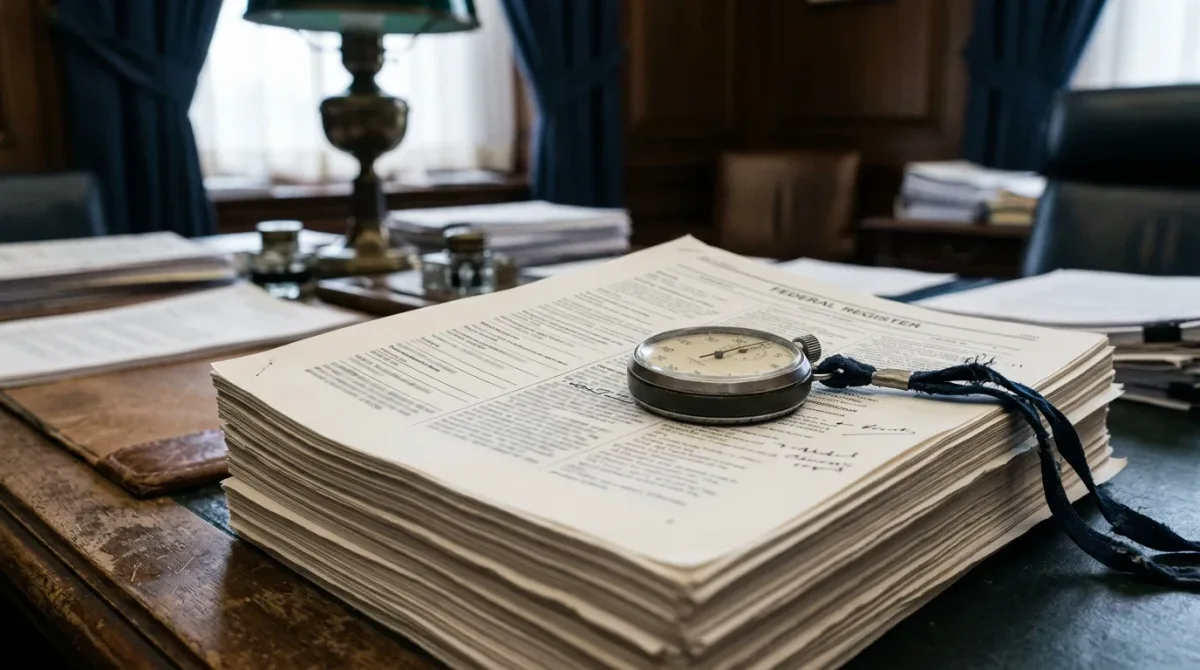
The Congressional Review Act is a 1996 procedural statute that lets Congress void a federal agency rule by simple majority in both chambers, with a presidential signature, inside a fixed window after the rule is submitted. Its force comes less from the vote than from the clock and the floor mechanics: Senate debate on a disapproval resolution is capped at 10 hours.
That cap is the whole design. Strip out the filibuster and the amendment tree, and a regulation that took an agency years to build can be extinguished in an afternoon of floor time. The argument of this explainer is that the CRA is best understood not as a veto over policy but as a scheduling device — one that converts a narrow calendar advantage into a permanent legal bar, because a disapproved rule cannot simply be written again.
What does the Congressional Review Act actually require?
It requires submission before effect. Under 5 U.S.C. 801(a)(1)(A), "[b]efore a rule can take effect, the Federal agency promulgating such rule shall submit to each House of the Congress and to the Comptroller General a report" on it. Submission starts the review period; without it, the review period never starts.
Section 801(a)(3) adds a delay for the biggest rules: a major rule takes effect on the later of 60 days after Congress receives the report or its publication in the Federal Register. Section 804(2) defines a major rule by economic weight — an annual effect on the economy of $100,000,000 or more, a major increase in costs or prices, or significant adverse effects on competition, employment, investment, productivity or innovation — and assigns the determination to the Administrator of the Office of Information and Regulatory Affairs, not to the issuing agency.
Section 804(3) draws the outer boundary. A "rule" carries its Administrative Procedure Act meaning but excludes rules of particular applicability on rates, wages and corporate structures, rules on agency management or personnel, and rules of agency organization, procedure or practice that do not substantially affect the rights or obligations of non-agency parties.
Why does the Senate procedure matter more than the vote count?
Because the Senate is where regulatory policy normally dies of delay, and the CRA removes the delay. Section 802 gives the disapproval resolution privileged treatment: a resolution introduced within 60 days of the report's receipt can be discharged from committee "upon a petition supported in writing by 30 Members of the Senate," and debate "shall be limited to not more than 10 hours," split evenly between supporters and opponents.
The statute also closes the usual exits. A motion further to limit debate is in order and not debatable; amendments, motions to postpone, motions to proceed to other business and motions to recommit are all out of order. A 51-vote majority that can hold together for one afternoon is therefore sufficient, which is why the tool is used almost exclusively when one party holds both chambers and the White House.
| Mechanism | Statutory figure | Provision |
|---|---|---|
| Report to both chambers and the Comptroller General | Required before the rule takes effect | 5 U.S.C. 801(a)(1)(A) |
| Delay on major rules | 60 days after receipt or publication, whichever is later | 5 U.S.C. 801(a)(3) |
| Window to introduce a disapproval resolution | 60 days after the report is received | 5 U.S.C. 802 |
| Senate discharge petition | 30 senators | 5 U.S.C. 802 |
| Senate floor debate | 10 hours, divided equally | 5 U.S.C. 802 |
| Major-rule economic threshold | $100,000,000 annual effect on the economy | 5 U.S.C. 804(2) |
What happens to a rule that Congress disapproves?
It stops, and the agency loses the power to try again. Section 801(b)(1) provides that a rule "shall not take effect (or continue)" once a joint resolution of disapproval is enacted. Section 801(b)(2) goes further: the rule "may not be reissued in substantially the same form," and a substantially similar new rule may not be issued, "unless the reissued or new rule is specifically authorized by a law enacted after the date of the joint resolution."
That second clause is the durable part. An ordinary appropriations rider lapses with the fiscal year; a CRA disapproval writes a standing prohibition into the agency's authority until Congress affirmatively lifts it. The statute never defines "substantially the same form," and it supplies no forum to argue about it, because 5 U.S.C. 805 states that "[n]o determination, finding, action, or omission under this chapter shall be subject to judicial review."
The Government Accountability Office sits inside the machinery rather than outside it. GAO reports to Congress on major rules that agencies submit, including summaries of the procedural steps the agencies took, maintains a searchable database of all rules submitted to it, major and non-major, and issues legal opinions on request about whether a particular agency action is a rule covered by the Act. Those opinions matter precisely because an unsubmitted rule has never started its clock.
Why do successful disapprovals cluster right after an election?
Because of the lookback. Section 801(d) applies the expedited procedures of section 802 to rules submitted in the closing stretch of a session, carrying them into the next one. Rules submitted during the 60 working days before a session ends are treated, per the George Washington University Regulatory Studies Center, "as though they were reported to Congress and published in the Federal Register on the 15th working day of the new session."
The effect is a second review window that opens for a new Congress and a new president on rules finalized by their predecessors. Writing in February 2024, Sarah Hay of that center counted 253 disapproval resolutions introduced between 1996 and 2022, 26 that passed both chambers and 20 that became law — one signed by President Bush, 16 by President Trump and three by President Biden. Nineteen of the 20, she found, fell within the lookback period.
What is the strongest case that the CRA is a weak check?
That the record is thin and the conditions are rare. Twenty enacted disapprovals across nearly three decades, against thousands of rules submitted each Congress, is a rounding error, and the same center's tracking notes that of 461 resolutions introduced from 1996 through 2024, the overwhelming majority went nowhere. A president will veto a resolution against his own agencies, and the CRA supplies no override; through February 2024, the center recorded nine resolutions clearing both chambers in the 118th Congress and every one of them vetoed.
The rebuttal is that counting enactments measures the wrong thing. The bar in section 801(b)(2) means each success removes a policy option indefinitely, not for a budget cycle, and section 805 removes the courts from second-guessing it. A tool used twenty times that permanently forecloses twenty regulatory paths is not the same object as a tool used twenty times with reversible effect.
What does this change for how rules are written?
The documents point to an agency incentive that runs on the calendar. Because section 801(d) exposes late-session rules to a fresh review window, and because section 801(b)(2) makes disapproval hard to undo, the statutory text rewards finishing consequential rules well before the lookback stretch rather than in the final weeks of an administration. That is an inference from the statute and the counted record, not a prediction.
It also puts weight on a quiet compliance step. A rule an agency never submits under section 801(a)(1)(A) has, on the statute's terms, no running clock — which is why GAO's opinions on what counts as a rule are a live procedural question rather than a bookkeeping one. USA Daily News 24 is an online publication, not a broadcast network, and this piece is an explainer of statutory process, not legal advice.
For a related national news perspective, read First New Agriculture Aircraft Type in 100 years by Edison Aerospace.
For more context, read First New Agriculture Aircraft Type in 100 years by Edison Aerospace.
For more context, read edison.
For more context, read Economic Benefits of a Sustainable Agricultural Revolution.