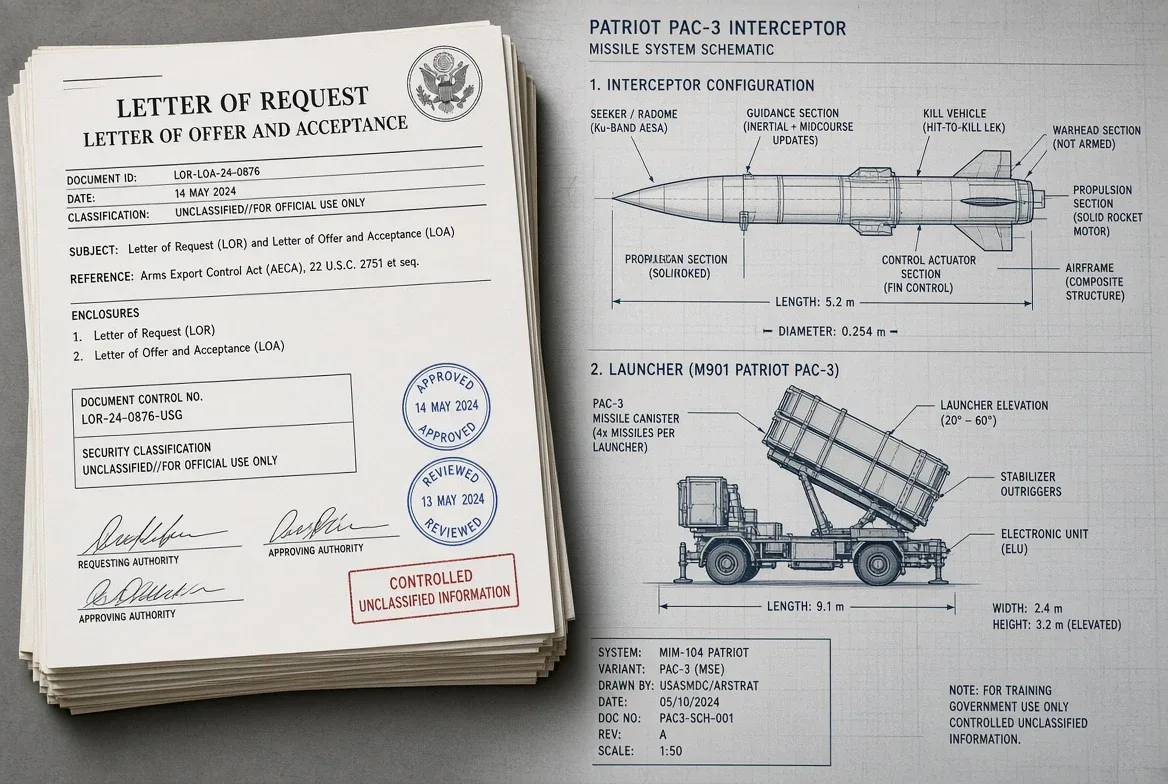
Foreign Military Sales is the U.S. government's own channel for transferring defense equipment to allied and partner nations, in which the Department of Defense — not the manufacturer — negotiates, prices, and delivers the deal under the Arms Export Control Act. The mechanism was on full display on January 30, 2026, when the Defense Security Cooperation Agency notified Congress of a possible $9.0 billion sale of Patriot Advanced Capability-3 (PAC-3) missiles to Saudi Arabia, a case that moved through the same sequence every FMS case follows.
That sequence is not a sales pitch. It is a defined administrative and legal process, documented in the Security Cooperation Agency's own Security Assistance Management Manual (SAMM), and it exists precisely because a government-to-government arms transfer carries obligations — legal, financial, and diplomatic — that a private export contract does not. EDN News 12 is an online publication, and what follows is a walk through that pipeline using the public record DSCA itself maintains.
What actually makes a sale a Foreign Military Sale?
A Foreign Military Sale is a transaction in which the U.S. government itself is the seller of record, buying the system from a U.S. contractor and then reselling it to the foreign government under a formal government-to-government agreement, according to the SAMM's description of the FMS case lifecycle. That is the structural difference from a Direct Commercial Sale, where a company sells and exports hardware to a foreign buyer directly under a State Department export license, with the U.S. government acting only as licensor rather than counterparty.
Because the Pentagon is the contracting party in an FMS case, it also becomes the guarantor of pricing, delivery, and follow-on support — which is why the SAMM ties the entire program to a rule with real financial teeth: the FMS system must recover its full costs, from the SAMM's own chapter on FMS financial policy. Nothing about the process is charitable; it is priced and billed like a government contract, because legally that is what it is.
How does a request for missiles become a case?
The formal record begins when a partner government submits a Letter of Request (LOR), a written request for specific defense articles or services that a Security Cooperation Organization at the U.S. embassy has already helped shape during informal planning, per the SAMM's chapter on the FMS case process. The LOR is screened against what the SAMM calls mandatory actionable criteria before the U.S. government commits time to building a real offer.
Once an LOR clears that screen, the relevant U.S. military department — the Army for a Patriot case — develops a Letter of Offer and Acceptance, the SAMM's binding government offer that sets out pricing, delivery schedules, terms, and conditions for the partner to sign. The sequence, condensed from the SAMM's own account, runs in five stages:
- Pre-LOR engagement between the partner and the Security Cooperation Organization to define the requirement and confirm funding.
- Submission of a written Letter of Request.
- Screening of the LOR against actionable criteria and development of a priced Letter of Offer and Acceptance.
- Congressional notification of the proposed sale, where required by dollar value.
- LOA signature by the partner nation and case implementation, delivery, and eventual case closure.
The Saudi PAC-3 case sits at stage four in DSCA's public notification list: a possible sale valued up to $9.0 billion, notified January 30, 2026, alongside four Israeli cases the same day covering Joint Light Tactical Vehicles, AH-64E Apache helicopters, Namer armored personnel carrier power packs, and AW119Kx light utility helicopters, according to DSCA's own list of major arms sales.
Why does Congress get a formal look before anything ships?
Congress built itself a review window directly into the Arms Export Control Act, and DSCA's implementing policy sets the dollar figures that trigger it. Under DSCA policy memorandum 02-34, a sale of Major Defense Equipment worth $14 million or more, or other defense articles and services worth $50 million or more, requires formal notification to Congress and a 30-day review period before the department can conclude the sale — figures that date to a September 2002 amendment of the statute, per the DSCA memo.
A separate, faster track applies to NATO members, Australia, Japan, and New Zealand: a 15-day review window, with higher dollar thresholds before notification is required at all, the same DSCA memo states. The Patriot missiles for Saudi Arabia — a non-NATO partner — accordingly moved on the standard 30-day clock once DSCA's notification hit Capitol Hill.
| Notification category | Major Defense Equipment | Other defense articles/services | Design & construction services | Review window |
|---|---|---|---|---|
| Most countries (standard) | $14 million+ | $50 million+ | $200 million+ | 30 days |
| NATO, Australia, Japan, New Zealand | $25 million+ | $100 million+ | $300 million+ | 15 days |
These thresholds are not a formality Congress can wave off after the fact. During the review window, individual members can raise objections that, as a practical matter, slow or reshape a case even without a formal resolution blocking it — a check the SAMM's process exists to accommodate, not bypass.
Who pays, and why doesn't the Pentagon absorb any of the cost?
Every FMS case is designed to recover its full cost from the buyer, not to subsidize the sale, according to the SAMM's chapter on FMS pricing and financial policy. That includes the cost of the hardware itself, nonrecurring research and development recoupment charges where applicable, contract administration, and an FMS Administrative Surcharge that funds the U.S. government's own work managing the case.
Payments flow through the FMS Trust Fund, a dedicated account the SAMM describes as the financial backbone of the program, in dollars, with billing tied to case milestones rather than a single lump payment. That structure is part of why an FMS case can run for years: the government is simultaneously the seller, the contract manager, and the treasurer of record for a transaction it does not itself get to profit from — full cost recovery, not margin, is the statutory design.
What happens after the Letter of Offer and Acceptance is signed?
Signature converts the LOA into an active case that the implementing military department executes against its own contract with the manufacturer, with delivery, training, and sustainment scheduled against the terms set in the LOA, per the SAMM's account of the case lifecycle. A case remains open, and billable, through delivery and any associated logistics or training support, closing only once all articles, services, and financial reconciliation are complete.
For the Saudi Arabia PAC-3 case, that means the January 2026 congressional notification is closer to the start of a multi-year process than its conclusion: the $9.0 billion figure DSCA published is the estimated program value at notification, not a final delivered price, a distinction the SAMM's pricing rules make explicit for every case still moving through implementation.
Why the process matters for reading the next arms-sale headline
Every large notification that appears on DSCA's list — the Saudi Patriot case, the same-day Israeli notifications, or the $2.316 billion P-8A and torpedo sale to Singapore notified January 20, 2026 — represents a case at the congressional-notification stage of the same five-step sequence, not a shipment. Reading the dollar figure without the process behind it means missing what is actually being reported: a legally defined offer has been made, a review clock has started, and a government-to-government contract, priced to recover its full cost, is what eventually gets executed. That is the whole trade.
For a related defense news perspective, read Economic Benefits of a Sustainable Agricultural Revolution.
For more context, read The Complete Guide to Gaming Genres.
For more context, read Two agencies decide every US dumping case.