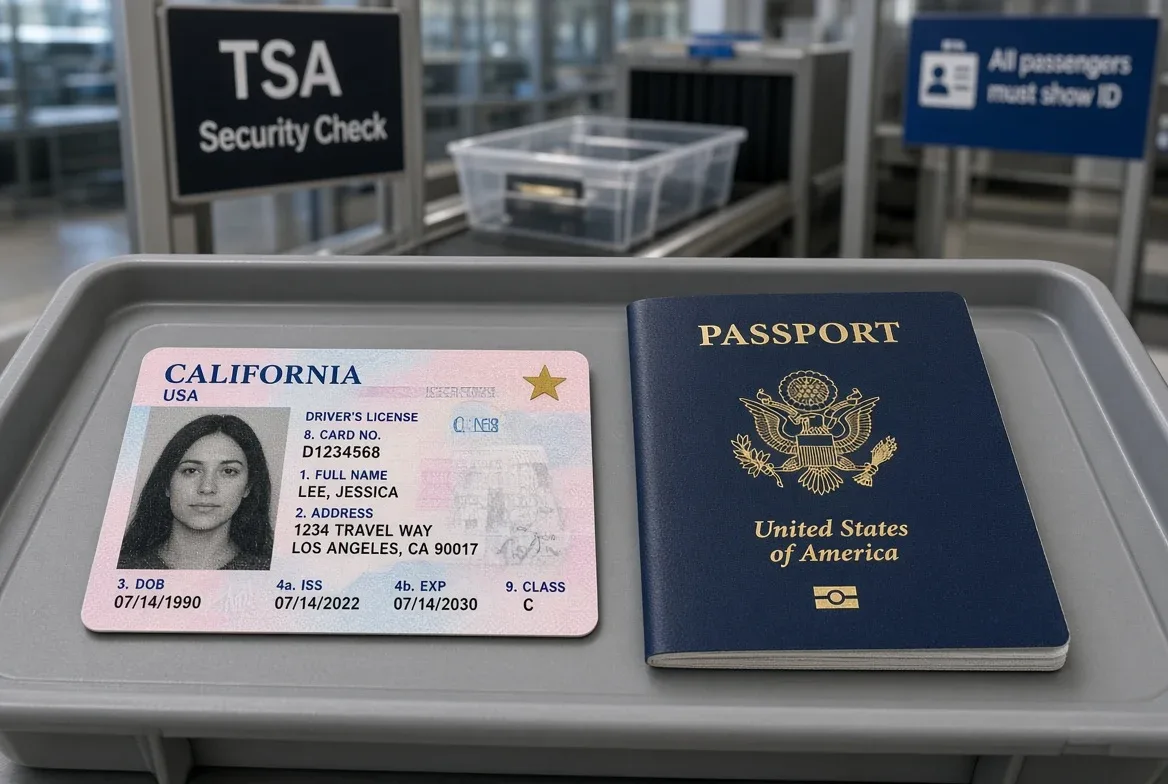
If you get to the airport without a REAL ID-compliant license, a passport, or another accepted form of ID, you can usually still fly — TSA runs an alternate identity-verification process instead of turning you away outright. As of February 1, 2026, that alternate path comes with a $45 fee, so the smarter move for U.S. domestic flyers is getting compliant ID before you travel, not at the checkpoint.
What REAL ID actually requires
REAL ID is a federal identification standard, not a new document type layered on top of your driver's license. Congress passed the REAL ID Act in 2005, following a recommendation from the 9/11 Commission, to set uniform verification standards for IDs used at federal checkpoints, according to TSA. Enforcement for domestic air travel began May 7, 2025, after repeated pandemic-era delays. Since that date, every air traveler 18 or older has needed a REAL ID-compliant license or another acceptable form of ID to pass through security, per TSA.
A REAL ID-compliant license is easy to spot: TSA says it's marked with a star at the top corner. If your license doesn't have that star, it isn't REAL ID-compliant, regardless of how recently it was issued.
What else counts as acceptable ID
A star isn't the only way through the checkpoint. TSA lists several accepted alternatives to a REAL ID-marked license: a valid passport, a passport card, a state-issued enhanced driver's license, a U.S. military ID, and a federally recognized tribal-issued photo ID. Any one of those works on its own — you don't need a starred license if you're traveling with a passport.
What happens if you don't have any of those
Showing up without acceptable ID doesn't automatically mean missing your flight. "In the event you arrive at the airport without acceptable identification (whether lost, stolen, or otherwise), you may still be allowed to fly," TSA says on its site. "By providing additional information, TSA has other ways to confirm your identity so you can reach your flight." The agency is also blunt about the ceiling on that leniency: "If your identity cannot be verified, you will not be allowed to enter the screening checkpoint."
When enforcement began in May 2025, Homeland Security officials described a deliberately lenient rollout rather than a hard cutoff, telling reporters that travelers without compliant IDs might be diverted to a different line or face an extra step, but would still be able to fly, with the process kept "as seamless as possible," Skift reported. At the time, TSA said more than 80% of passengers at checkpoints were already using a REAL ID or another acceptable form of ID, even as long lines built up at driver's license offices in several states that were still catching up.
The $45 fee, explained
That leniency now has a price tag. Since February 1, 2026, TSA has charged a $45 fee to travelers who show up without a REAL ID or passport and need the alternate identity-verification process, according to Skift. The fee covers a 10-day window, so it doesn't need to be paid every time you fly during that stretch. TSA has said the charge "is meant to cover the technology and administrative costs of confirming the identities of travelers" who go through the alternate process. The figure also landed well above an earlier $18 proposal, reflecting the cost of running that verification system at scale.
The fee doesn't change who gets stopped at the checkpoint — it changes what happens next for the people who already would have gone through extra verification. It's the kind of cost that shows up once, unexpectedly, and then shapes how you pack your wallet for every flight after.
Who should deal with this before their next flight
If you fly domestically and your license doesn't have the star, this is a solvable problem, not a surprise for departure day. TSA directs travelers to their state's driver's licensing agency to get a REAL ID-compliant license; wait times vary by state and were still long in some places as of last year's rollout, per Skift's reporting, so it's worth starting before a trip is booked, not the week of. Frequent flyers who already carry a passport can skip the DMV trip entirely — a valid U.S. passport clears the same checkpoint requirement as a starred license, with no expiration-date footnote needed here since TSA lists it as accepted on its own.
What if you're just visiting and don't have a U.S. license at all?
International travelers arriving with a valid passport meet the ID requirement the same way a domestic flyer with a passport does — REAL ID only applies to state-issued licenses and IDs, not to passports, which TSA accepts regardless of REAL ID status.
For a related shopping perspective, read How the VAT refund actually works when you shop in Europe.
For more context, read The Complete Guide to Gaming Genres.
For more context, read Federal Law Sets a Five-Year Floor on Gift Card Expiration.
For more context, read The federal noncompete ban is dead. State law never was..