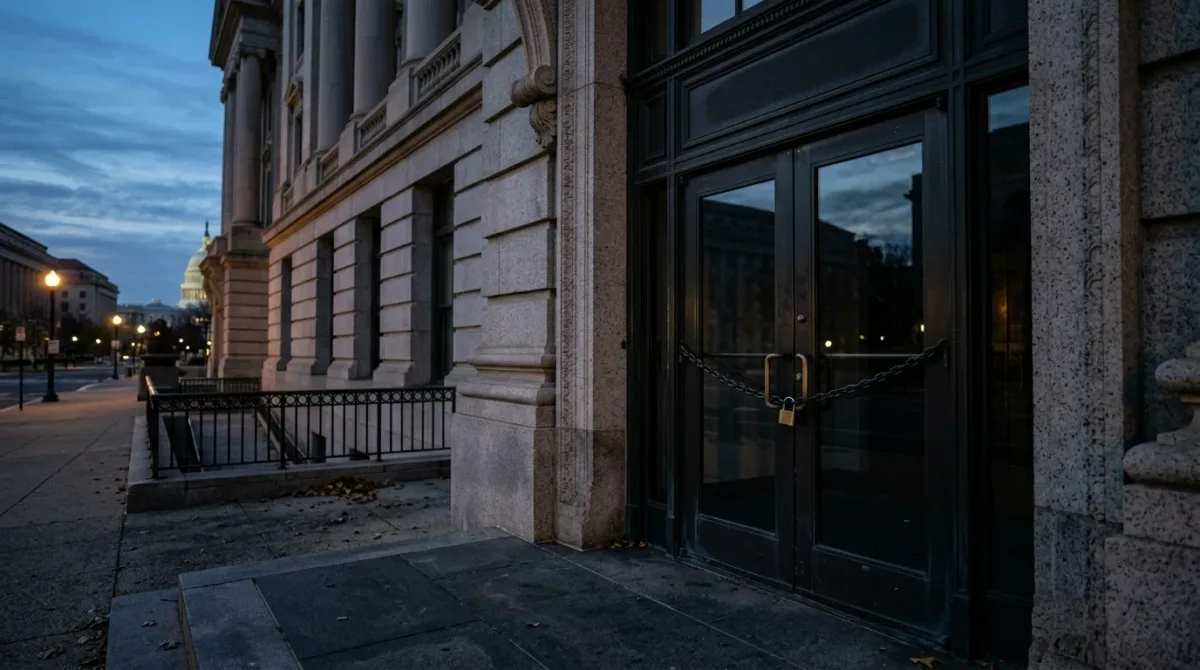
Every few years, the same warning returns to Washington: the government is about to shut down. The phrase sounds abstract until it happens, and then it becomes very concrete for the roughly two million people who work for federal agencies and the public that depends on them. But a shutdown is not a discretionary decision by the president or a single agency. It is the automatic legal consequence of a funding gap, activated by a Civil War-era law that most Americans have never heard of: the Antideficiency Act.
The mechanism starts with Congress's basic constitutional job. Federal agencies cannot spend a dollar that lawmakers have not appropriated. When Congress and the president fail to enact the twelve annual appropriations bills, or a stopgap measure standing in for them, before the fiscal year's funding runs out, a gap opens. The Government Accountability Office defines that gap precisely: a shutdown is "a period of time between the expiration of an appropriation and the enactment of a new one," and GAO's own accounting shows it has happened twenty times between 1977 and 2019, lasting anywhere from one day to 35.
What law actually forces agencies to stop working?
The trigger is not a shutdown order from the White House. It is the Antideficiency Act, which GAO describes as requiring that when a funding lapse occurs, "agencies generally stop their operations." The statute exists to protect Congress's constitutional power of the purse by making it illegal for the executive branch to spend or commit money it has not been given. In GAO's language, the law "prohibits agencies from incurring obligations or making payments in advance or in excess of an appropriation."
That prohibition reaches further than payroll. Agencies "generally may not spend money during a shutdown, including for employee salaries," and federal staff cannot even volunteer their labor for free, since the law bars the government from accepting "services without payment—except in very limited circumstances." In practice, this is why furloughed employees are legally barred from checking work email or logging into government systems during a lapse, not just discouraged from it.
Why do some offices stay open anyway?
If shutdowns froze every federal function, air traffic control towers and Social Security checks would stop along with passport offices and national parks. They do not, because GAO lays out what amounts to a two-step legal test agencies apply once funding lapses. First, any activity with its own funding source outside annual appropriations can continue — GAO's example is Social Security, which "is funded through a permanent appropriation, and they may continue" paying benefits regardless of a lapse elsewhere in government. Second, for everything else, only work that fits narrow emergency exceptions survives, limited to functions "necessary to protect human life and government property."
That second category is why air traffic controllers, active-duty troops, and federal law enforcement keep reporting for duty during a shutdown while regulatory reviews, grant processing, and routine inspections stop. GAO is explicit that the exceptions are not a loophole for keeping government running as usual: "the ongoing, regular functions of government may not continue during a shutdown," even where a case could be made that the work matters.
Do federal employees get paid during a shutdown?
No — and this is the detail most frequently misunderstood. Whether an employee is furloughed or classified as "excepted" and ordered to keep working, both groups go unpaid while the lapse continues. As Government Executive's guide to shutdown pay and benefits puts it, "neither furloughed federal workers nor those deemed essential and forced to work during a shutdown will be paid during a shutdown." Excepted employees do eventually receive premium pay for the hours they worked without a paycheck, but only "after the government reopens," not while the shutdown is underway.
What changed after the 35-day shutdown that ended in early 2019 is that back pay is no longer optional. Government Executive notes that in earlier lapses, "Congress needed to approve back pay for furloughed workers following each shutdown" — a separate political fight layered on top of reopening the government. Since the law enacted at the close of that 2018-2019 shutdown, "all federal workers will be automatically granted back pay once funding has been restored," removing that extra round of negotiation.
That guarantee is also the strongest counterargument to treating shutdowns as pure fiscal discipline: if furloughed employees are made whole automatically, the leverage a shutdown creates falls almost entirely on agency operations and the public waiting on services, not on the workforce's paychecks in the long run — even though the missed paychecks during the lapse itself are real and immediate for households budgeting week to week.
How do stopgap bills prevent, or just delay, a shutdown?
Most years, Congress avoids finishing all twelve appropriations bills on time and instead passes a continuing resolution, or CR — what GAO calls "temporary spending bills that allow federal government operations to continue when final appropriations have not been approved by Congress and the President." A CR generally freezes funding at the prior year's levels rather than setting new amounts, buying time without resolving the underlying budget disputes. GAO notes that Congress has completed the full regular appropriations process before the new fiscal year began only three times in the last 47 years, which is why CRs have become the default tool for keeping agencies open.
A CR is not a permanent fix, and GAO warns it carries its own costs: stopgap funding produces "administrative inefficiencies and limited management options in areas such as hiring and travel" even when it succeeds at averting a lapse. The real risk moment is what happens when a CR itself expires without a follow-on bill. GAO's review of the 2010-2022 period found 47 CRs enacted, but on three occasions — fiscal years 2014, 2018, and 2019 — no CR was in place when funding ran out, and each produced an actual shutdown.
What this means the next time a deadline approaches
A shutdown fight in Washington is often covered as political theater, but the underlying process is mechanical and legally constrained. Once a funding gap opens, the Antideficiency Act does not leave agencies discretion — it dictates what must stop, what narrowly qualifies to continue, and that employees on both sides of that line go unpaid until Congress acts. Understanding that structure is what separates a genuine countdown to consequences from routine last-minute deal-making that resolves before any lapse occurs. The clearest signal to watch for is not rhetoric but the calendar: whether a CR or final appropriations bill is signed before the prior one's funding runs out.
For a related national news perspective, read How Congress Kills a Federal Rule Without Writing New Law.
For more context, read Bid Protests: How the 100-Day Clock Actually Works.
For more context, read How the WARN Act's 60-Day Clock Actually Works.
For more context, read How Countervailing Duty Investigations Actually Work.