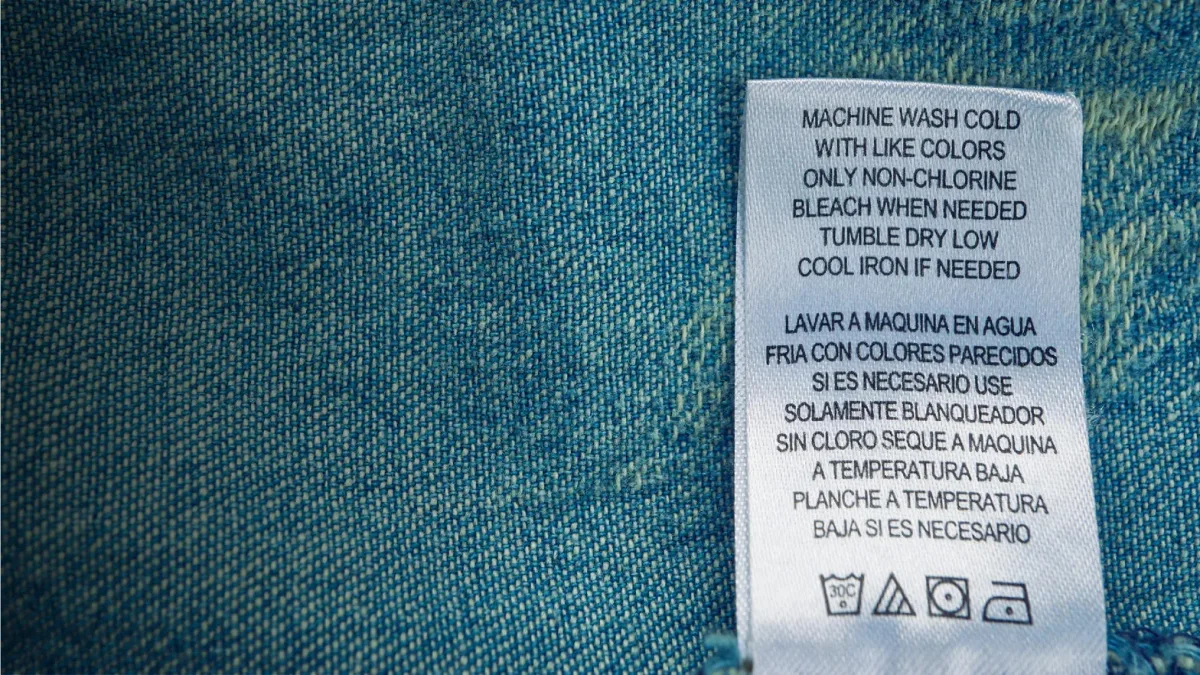
A care label is a legal disclosure, not a design flourish: under the Federal Trade Commission's Care Labeling Rule, codified at 16 CFR Part 423, every garment sold in the United States must carry a permanent label giving a full care method, either washing or drycleaning, plus any warning needed to prevent damage — unless the item is fully reversible and pocket-free.
What Exactly Must Appear on a Care Label?
The rule requires a label that states one complete, workable method of regular care rather than a partial hint. A washing instruction must specify the method — machine or hand — and the water temperature; a drycleaning instruction must name the compatible solvent, per 16 CFR Part 423. If any part of a normal care routine could damage the garment, the label must say so explicitly, using warnings such as "Do not bleach" or "Wash separately." The label must be attached permanently enough to remain legible for the useful life of the item, and it must be visible at the point of sale — if outer packaging hides it, the same information has to reappear on the package exterior or a hang tag.
The rule also builds in relief for garments that genuinely need none of this. An item that can withstand any normal washing or drycleaning method needs only the single line "wash or dry clean, any normal method." Certain reversible garments and goods sold to institutional or commercial buyers can use alternative labeling arrangements rather than the standard permanent tag.
How Do the Pictorial Symbols Fit Into a Legal Requirement?
Text is not the only way to satisfy Part 423. The rule permits pictorial care symbols in place of, or alongside, written instructions, provided the symbol system used meets the underlying disclosure requirements. The reference system is ASTM D5489, a standard maintained by ASTM International that defines a single-color set of pictograms covering five operations: washing, bleaching, drying, ironing, and professional textile care, according to ASTM's published standard. The stated purpose of that symbol set is to let a buyer select and maintain a garment without depending on the label's language — useful for goods that move through import and export channels before they reach a US rack. When the FTC folded symbol-based labeling into the rule, it required a transition period during which any symbols used still needed accompanying text explanations, so a manufacturer switching to pictograms did not strand shoppers unfamiliar with the icons.
Why Does a Separate Regulation Cover the Fiber Content Line?
Care instructions are governed by one regulation; what a garment is made of is governed by another. The Textile Fiber Products Identification Act rules, at 16 CFR Part 303, require every textile product to list fiber content by generic name, in descending order by weight, in lettering of uniform size — a manufacturer cannot print "98% Cotton" in bold and bury a synthetic blend fiber in small type. A fiber present at less than 5% of the garment's weight can be folded into a generic "other fiber(s)" line unless that fiber does something functional, such as adding stretch. The rule also fixes the generic names manufacturers must use — cotton, polyester, nylon, acrylic, and so on, set out in the regulation's own list — and a brand's trademarked fiber name can sit next to the generic term but cannot replace it on the label or in advertising, per 16 CFR Part 303.
| Requirement | Governing rule | What it controls |
|---|---|---|
| Care instructions | 16 CFR Part 423 (Care Labeling Rule) | Washing or drycleaning method, water temperature or solvent, damage warnings |
| Fiber content | 16 CFR Part 303 (Textile Fiber Products Identification Act rules) | Generic fiber names, order by weight, the 5% "other fiber" threshold |
| Manufacturer identity | 16 CFR Part 303, via the FTC's RN system | A registered number standing in for a full company name |
| Country of origin | 16 CFR Part 303 | Where the item was processed, assembled, or made |
What Is an RN Number, and Why Do Brands Bother Registering One?
A tag that reads "RN 12345" instead of a company's full legal name is not an evasion; it is a substitution the regulation explicitly allows. Under Part 303, a manufacturer, importer, or marketer can obtain a registered identification number from the FTC and print that number on the label in place of its complete business name, provided it keeps its registration current. The FTC maintains a public RN database that lets anyone search a number back to the business behind it, filtering by business type — importer, manufacturer, retailer, wholesaler, or other — according to the FTC's RN database tool. The number is not transferable between companies and is subject to cancellation if the registrant misuses it or lets its filing go stale, which is the leverage that keeps the system self-policing: a defunct or sold-off label operation cannot keep trading on someone else's number.
Where Does Country of Origin Fit on the Same Tag?
Part 303 also requires the label to say where the garment was processed or manufactured. A domestic product states "Made in U.S.A."; an imported one names the country of origin. Goods assembled across more than one country need the stages disclosed rather than compressed into a single claim — the regulation's own example is a label reading "Knit in USA, assembled in [Foreign Country]," which keeps a multi-country supply chain legible on a two-inch tag rather than letting one processing step stand in for the whole garment's history.
What Happens When a Label Doesn't Comply?
Both rules run through the same enforcement channel. Neither Part 423 nor Part 303 spells out a separate penalty schedule; instead, each treats a violation as an unfair or deceptive act or practice under the FTC Act, which is the same statute the agency uses to police mislabeled ingredients or fake discounts elsewhere in retail. That framing matters for how a compliance failure gets treated: it is not a labeling technicality but a consumer-protection violation, which is why brands with any meaningful US distribution build fiber content, care instructions, RN registration, and country-of-origin disclosure into a single pre-production checklist rather than treating the sew-in tag as an afterthought once the garment itself is finished.
None of this touches what a garment looks like or how it's marketed — it governs a fixed set of facts a manufacturer must disclose before the item reaches a hanger. The two-inch label most shoppers never read twice is, functionally, the compliance record for the whole production run behind it.
For a related style news perspective, read 24FASHION IS A NEW GLOBAL FASHION NETWORK AND TV CHANNEL ON AMAZON FIRE TV AND ROKU TV.
For more context, read How the WARN Act's 60-Day Clock Actually Works.
For more context, read Bid Protests: How the 100-Day Clock Actually Works.
For more context, read How a Federal Government Shutdown Actually Works.