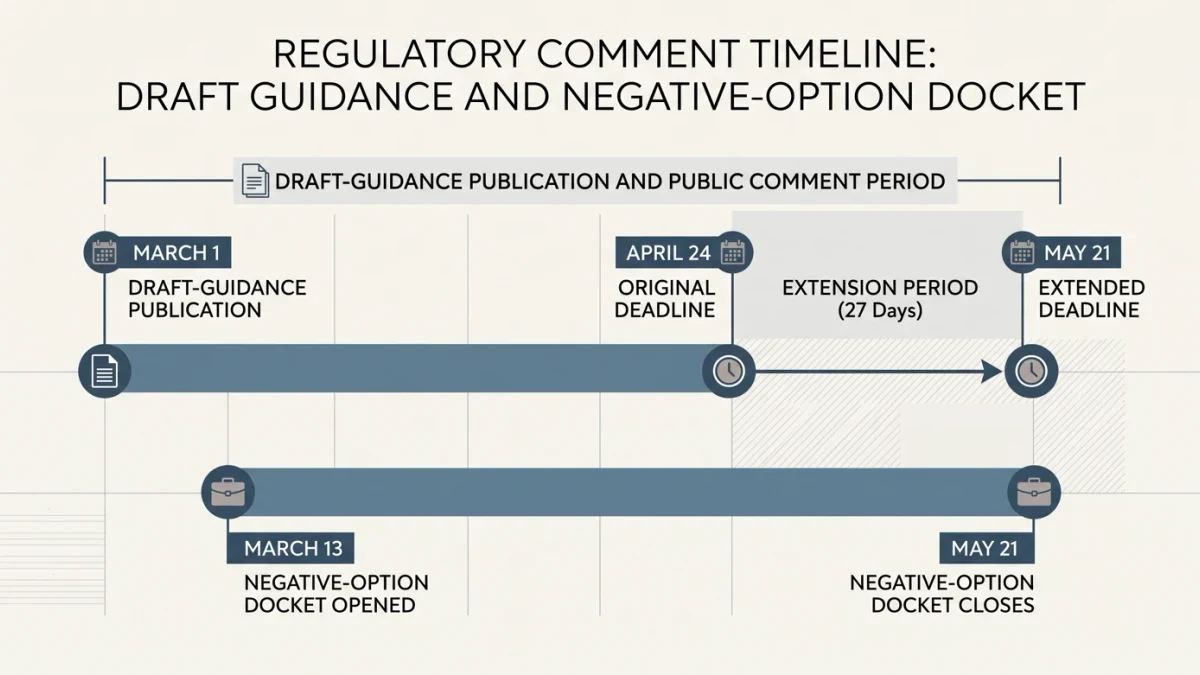
The Justice Department's Antitrust Division and the Federal Trade Commission launched a joint public inquiry on February 23, 2026 into whether the agencies should issue new or updated guidance on competitor collaborations, per the FTC. The request, docketed as ATR-2026-0001 on regulations.gov, seeks comment on the value and content of guidance covering joint ventures, strategic alliances and technology-driven partnerships. The original comment deadline was set for April 24, 2026.
This publication covers the policy process, not legal advice; businesses weighing comments should consult counsel. The commercial stakes are straightforward.
What is on the table?
US antitrust law polices agreements among competitors, but the agencies' written guidance on lawful collaborations is fragmented across decades-old documents — the 2000 competitor collaboration guidelines, sector-specific joint venture statements, and ad hoc policy papers. Per the FTC's announcement, the inquiry asks whether that patchwork still describes enforcement practice, especially for collaborations built on data sharing, AI development and platform ecosystems that did not exist when the older guidance was written.
Why businesses care about the rules
Companies structure collaborations constantly: automakers co-developing battery platforms, hospitals sharing billing systems, airlines codesharing, retailers building joint purchasing ventures. Each structure sits somewhere on the line between pro-competitive efficiency and per se illegal price or output coordination. Guidance does not bind courts, but it signals where the agencies will look first — which negotiations get scrutinized, which information exchanges are treated as red flags, and how benchmarking or data-pooling arrangements are analyzed.
- Trade associations use comment periods to push for safe-harbor language around standard-setting and benchmarking.
- Healthcare systems track how the agencies treat clinical integration and shared-savings ventures.
- Technology firms weigh in on data-sharing and joint AI development, where collusion and cooperation are hardest to distinguish.
How the process runs
Comments go through regulations.gov in the ATR-2026-0001 docket. The agencies later extended the deadline to May 21, 2026, per a DOJ announcement, giving trade groups and in-house teams a longer runway. Guidance, if issued, would follow a review of the submissions and would not itself carry force of law — but it would set the analytical starting point for both agencies' investigations.
What the agencies asked
The inquiry's questions run to specifics: whether existing guidance adequately addresses data sharing and joint AI development, how market-definition tools apply to multi-firm platforms, and what safe harbors, if any, should tell companies when a collaboration is unlikely to draw scrutiny. Per the FTC, the agencies also asked which legacy statements should be withdrawn entirely rather than updated.
What does this change?
Nothing immediately, and that is the point of the exercise: the agencies are writing the rules of engagement for the next wave of alliances before enforcement disputes define them case by case. Companies already in, or contemplating, ventures with direct competitors have a documented window to argue for clearer boundaries. The last comparable rewrite of collaboration thinking predated the smartphone; the submissions filed by May 21, 2026 will shape how the next generation of joint ventures is lawyered.