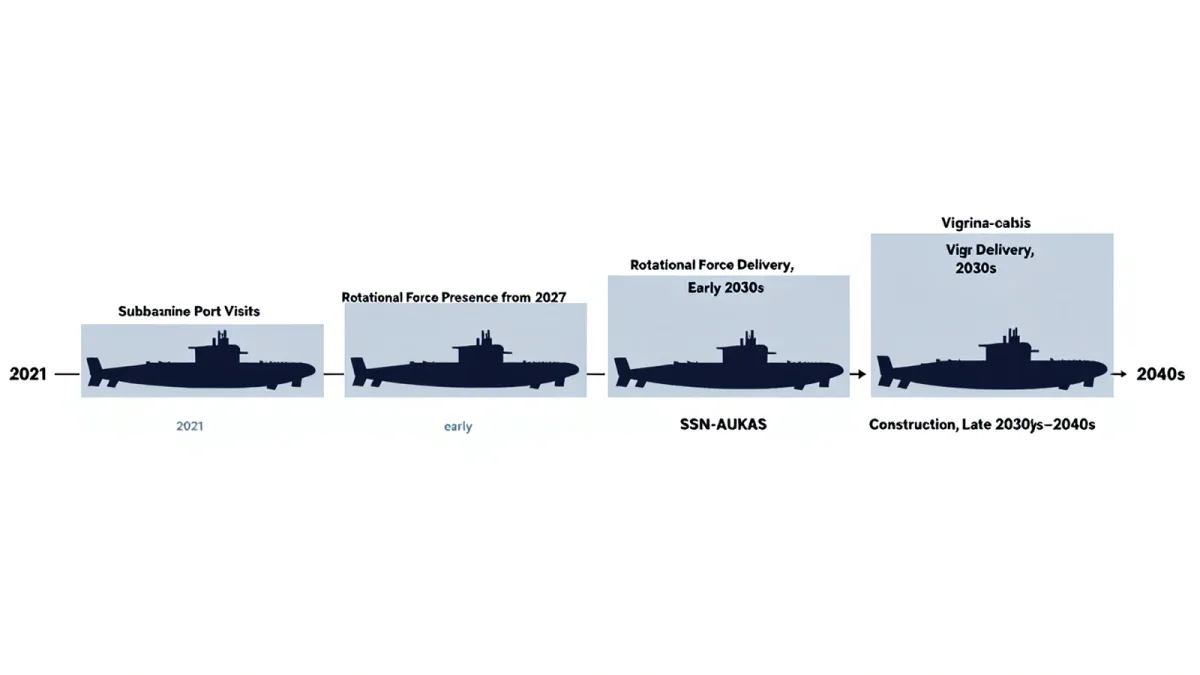
AUKUS Pillar II is the technology half of the Australia-United Kingdom-United States partnership: an agreement, announced with Pillar I in September 2021, to jointly develop advanced military capabilities — undersea systems, hypersonics, electronic warfare, artificial intelligence, quantum sensing, and cyber — rather than nuclear-powered submarines. By the March 2023 San Diego leaders' summit, the three governments had organized it around eight named capability lines.
Pillar I gets the headlines because it involves selling Virginia-class submarines to Australia. Pillar II matters for a different reason: it is a standing framework for co-developing weapons technology with two allies, with export-control exceptions and shared requirements built in. This explainer lays out what is actually in it, based on the 2021 joint statement, the 2023 San Diego announcement, and subsequent trilateral statements through 2025.
Why does the partnership have two pillars at all?
The original September 2021 announcement was only about submarines. But the three governments added a second track to keep the partnership from being hostage to one 20-year shipbuilding program. The March 2023 San Diego statement formally divided AUKUS into Pillar I — the Optimal Pathway to Australian nuclear-powered submarines — and Pillar II, "Advanced Capabilities." The logic was industrial as much as military: Pillar I takes decades and billions; Pillar II could show results on shorter cycles and keep political momentum behind the whole arrangement.
What technologies are actually in Pillar II?
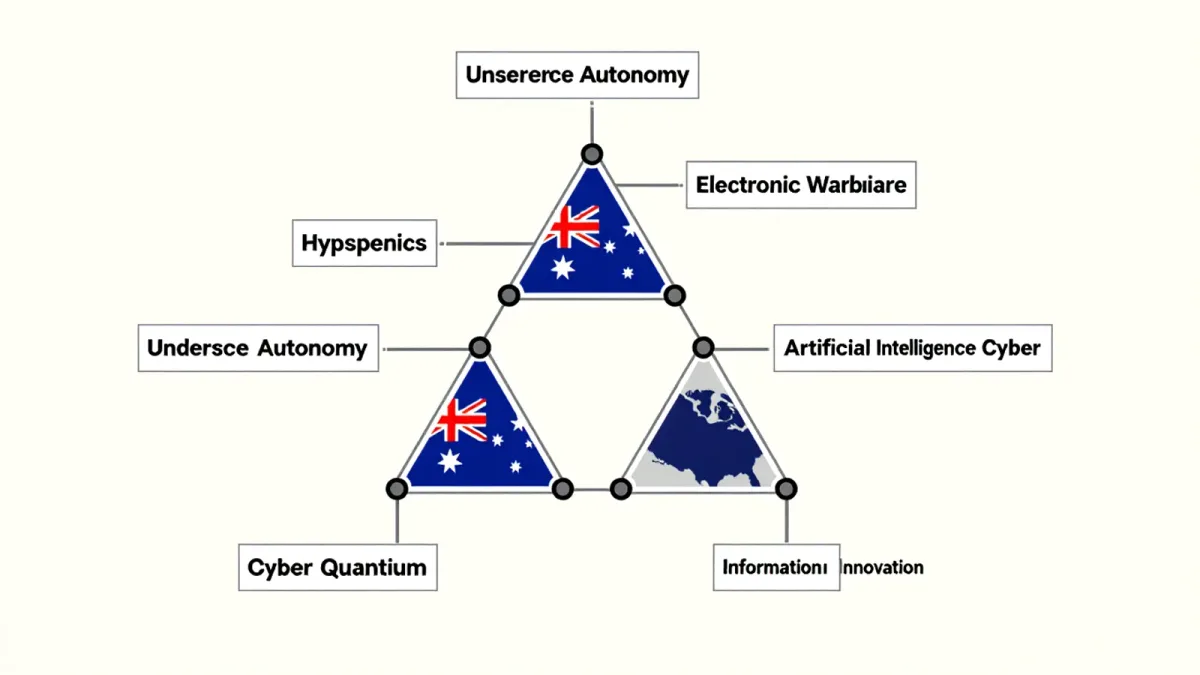
The trilateral statements name eight lines of effort. Public documents describe the work at varying depth:
- Undersea capabilities. Autonomous undersea vehicles and seabed warfare technology. This line has produced the most visible trials, including joint maritime autonomous exercises in Australian waters.
- Hypersonic and counter-hypersonic. Co-development of hypersonic cruise vehicles and defenses against them, building on the 2021-2023 US-Australia hypersonics work under SCIFiRE.
- Electronic warfare. Shared requirements and testing for the electromagnetic spectrum fight.
- Artificial intelligence and autonomy. Joint AI experimentation, including autonomy trials where unmanned vehicles operated together at sea.
- Quantum technologies. Sensing, timing, and navigation research with defense applications.
- Cyber. Offensive and defensive cyber cooperation, largely undisclosed in detail.
- Information sharing. Legal and technical pipes to move classified data among three governments and their industries.
- Innovation acceleration. Joint funding vehicles and industry challenges to pull small companies into trilateral programs.
What has Pillar II actually delivered so far?
The honest ledger, as of early 2026, runs from concrete to aspirational. On the concrete side: repeated trilateral autonomy and AI trials, recurring joint exercises for unmanned maritime systems, and a negotiated relaxation of the US International Traffic in Arms Regulations for most AUKUS-related transactions — a 2024 rule change that removed licensing requirements for many defense technology transfers among the three countries. On the aspirational side: hypersonic co-development remains largely at the research stage, and quantum and electronic warfare efforts have produced statements of intent more than fielded systems. Congressional Research Service reports have repeatedly noted that Pillar II's outputs are hard to verify because most work is classified.
Could other countries join?
Yes, selectively. The three partners have explored bringing Japan into specific Pillar II projects — cooperation on autonomy and machine learning was discussed from 2023 onward. The structure allows "non-traditional partners" on a project-by-project basis, which is why Pillar II is sometimes called the partnership's diplomatic device: it gives allied governments a way to plug into AUKUS without touching the submarine program, whose politics are settled among exactly three countries. South Korea, Canada, and New Zealand have each expressed interest in defined projects.
How does industry participate?
Pillar II was designed from the start to reach beyond primes. The trilateral governments have run recurring industry-focused events — defense innovation summits and investor showcases in each capital — aimed at pulling startups and mid-sized firms into trilateral projects, alongside existing national innovation bodies such as the Defense Innovation Unit in the United States and the UK's Defence Science and Technology Laboratory. The visible mechanism is project-based: governments post trilateral challenges — autonomy, undersea sensing, AI tooling — and combine national funding on selected efforts. The friction point the companies themselves report, echoed in congressional testimony on both sides of the Atlantic, was export licensing: the time and cost of moving controlled technology among three countries threatened to outweigh the benefits of cooperation, which is exactly the problem the 2024 ITAR exemptions were written to solve. The participation model matters because it is the test of the partnership's second promise — that AUKUS would change not only what allies buy, but how three defense-industrial bases design things together.
What are the main critiques on the record?
Congressional researchers and defense analysts have raised three documented concerns. First, oversight: because most Pillar II work is classified and distributed across three national bureaucracies, CRS reports note that legislators in all three countries struggle to see the full picture, which complicates both funding oversight and public accountability. Second, coherence: the eight capability lines share a name more than a budget — there is no single trilateral program office with authority across them, so critics question whether Pillar II is a program at all or a diplomatic label over national efforts that were already underway. Third, capacity: Pillar I's submarine costs dominate the political bandwidth of all three governments, and analysts have warned that Pillar II could become a casualty of Pillar I's industrial strain if attention and money crowd out the technology track. Defenders respond that the export-control reforms and the joint-trial cadence are themselves durable achievements, and that co-development pipelines take a decade to produce fielded systems — a defense that, notably, asks for the same patience Pillar I already demands.
What does this change?
Pillar II's real product may be procedural rather than kinetic: the export-control carve-outs and shared requirements processes it normalizes are the machinery that lets three national defense industries build one system — something NATO interoperability efforts have pursued for decades with limited success. Watch two markers: whether a Pillar II capability reaches production with trilateral supply chains, and whether the Japan model of project-level participation expands. If both happen, Pillar II will have changed how the United States shares defense technology, independent of whether any single weapon system it sponsored succeeds.