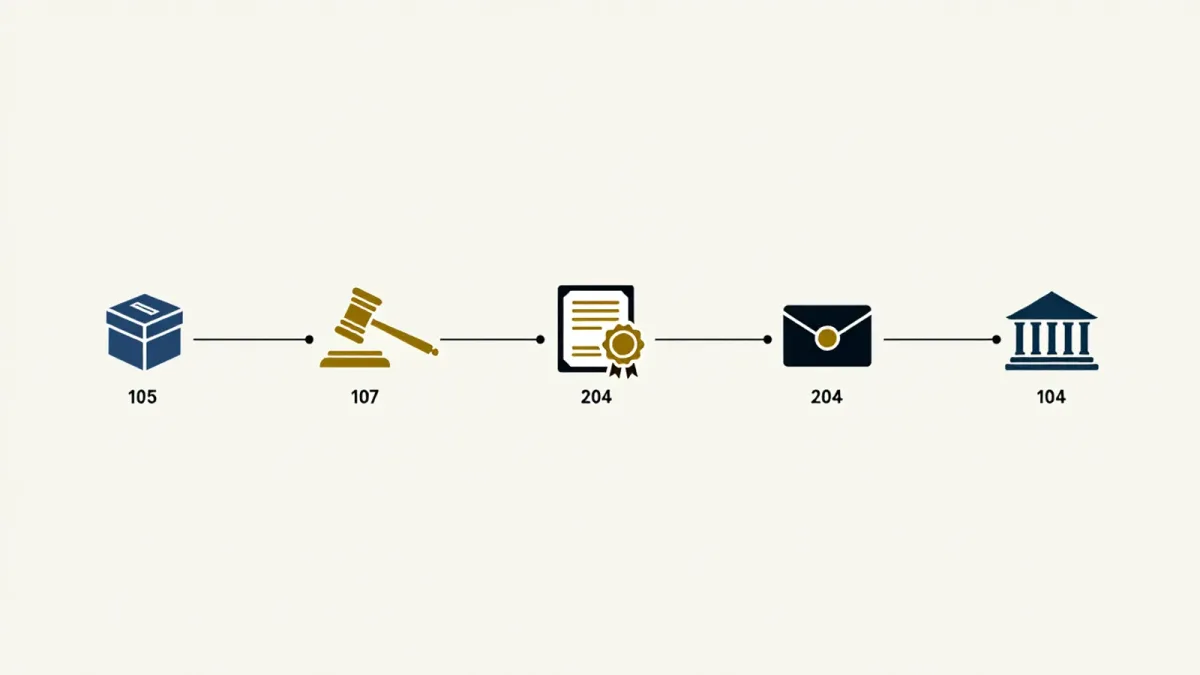
The Electoral Count Reform Act of 2022 rebuilt the federal rules for counting Electoral College votes: it strips the vice president of any substantive role, raised the objection threshold in each chamber from one member to one-fifth of the body, and created an expedited court process to settle which slate of electors a state's certificate actually carries. Congress enacted it as Division P of the Consolidated Appropriations Act, signed into law on December 29, 2022, as Public Law 117-328, and its first full test in a presidential count arrives in January 2027.
The statute answers a specific record. On January 6, 2021, a joint session of Congress paused for hours while objections to Arizona's and Pennsylvania's electoral votes were debated, and the sitting vice president faced public pressure to reject certified state results — pressures the original Electoral Count Act of 1887 never clearly resolved. The 2022 rewrite targets each ambiguity in turn.
Why did Congress rewrite a law from 1887?
The Electoral Count Act of 1887 governed the joint session but left open who decides disputes over a state's electors. Its language described the president of the Senate as performing a count while allowing objections, and it preserved a route for states to submit competing slates — the gap that post-2020 elector schemes tried to use. The Electoral Count Reform Act, passed with bipartisan majorities in both chambers in December 2022, replaces that framework with rules that assign decisions to offices with defined legal authority rather than leaving them to improvisation at the rostrum. elections coverage.
What is the vice president's role now?
Ministerial, and the statute says so. The reform act states that the president of the Senate — customarily the vice president — shall open the certificates and have them counted "in the order in which they are received," with no discretion to reject a certificate, delay a count, or declare an alternative result. Any power that existed under the old law's ambiguous phrasing is written out of the text. The joint session also must proceed without a motion to suspend, and the law directs the count to continue until complete.
How hard is it to object now?
Substantially harder. Under the 1887 act, an objection required only one senator and one representative in writing. The 2022 law raises the requirement to at least one-fifth of the members present and voting in each chamber — roughly 87 senators and 87 representatives at full attendance — before a dispute even reaches a chamber vote. Both chambers then must sustain the objection under their own rules for a state's votes to be excluded, a bar no objection has cleared since the count became a formal proceeding.
What about competing slates of electors?
The reform act closes the door the fake-elector documents tried to walk through. Under the new text:
- One certificate, one official. Only the chief executive of a state — the governor, or a designated substitute where the law specifies — submits the state's certificate of ascertainment, ending the historical worry that rival officials could send rival slates.
- Appointment on election day. Electors must be appointed on election day itself, with a narrow exception for elections disrupted by natural disaster or calamity, which forecloses any legislative reset of a finished election.
- Failure-to-vote rule. Electors who decline to vote are treated as absent, not replaced by a shadow slate, and the count proceeds on the votes actually cast.
- Fast courts. A state's or a candidate's challenge to a certificate goes to a three-judge federal panel, with direct appeal to the Supreme Court, so disputes resolve on a legal clock rather than a political one.
What stayed the same?
The architecture survives. Electors still meet in their states on the first Tuesday after the second Wednesday in December, their votes still open in a joint session of Congress on January 6, and a candidate still needs a majority of electoral votes — 270 out of 538 — to win. The Twelfth Amendment's separation of presidential and vice presidential ballots still governs, and Congress retains the constitutional power to reject votes or void an election under the quorum and counting rules that long predate the 1887 act. What changed is procedure, not outcome standards: the reform act does not alter who may vote, how ballots are counted, or how state recounts work. It adjusts who may act at each federal step and on what evidence, leaving the underlying election machinery to the states. That is why election officials' groups supported the bill in 2022 — it codified practices they already followed, such as a single certifying official per state, rather than redesigning their systems.
How does it interact with state certification?
The federal law now leans on state law rather than competing with it. Certification of results remains a state legal process — canvassing boards, recounts, and contests run under each state's code — and the reform act's certificate of ascertainment simply carries the state's legal outcome to Washington. Because the governor is fixed as the certifying official and courts get an express, expedited path to order corrections, a losing faction cannot shop for a friendly officer to transmit a rival slate; any competing claim has to win in court, on a docket measured in days, before the count. The design also protects against legislative after-the-fact rewrites: since appointment happens on election day, a legislature cannot meet in December and award electors to a candidate who lost the popular vote in November. The interlocking deadlines are tight by intent — state determination, judicial review, certificate issuance, and the congressional count each have a defined slot, and a miss at one stage no longer opens space for improvisation at the next.
Did the calendar change too?
Yes, in two places. The 1887 "safe harbor" date — December 8 in 2024, by which a state's determination was conclusive — sat awkwardly against certification deadlines, and the reform act rebuilt the timeline around the day electors vote, the first Tuesday after the second Wednesday in December under 3 U.S.C. Section 7. A state's certificate of ascertainment must issue at least six days before the electors meet, and court-ordered corrections can still arrive between that deadline and the count, with the expedited panel process guaranteeing a ruling. Congress still counts the votes in a joint session on January 6 following the election, a date the reform act preserved.
What does this change in practice?
It moves decision points away from the joint session and toward institutions with rules and clocks. Governors certify; courts adjudicate within days; the vice president reads results; and objections need a floor of support that has never been reached. The mechanism does not make disputes impossible — certification fights still happen in state courts and recounts still run under state law — but the federal count itself now runs on instructions rather than custom. The 2022 law's first scheduled examination on a national scale comes with the count on January 6, 2027, and the standard for judging it is the one the statute wrote: a count that opens certificates, hears only properly supported objections, and reports a total.