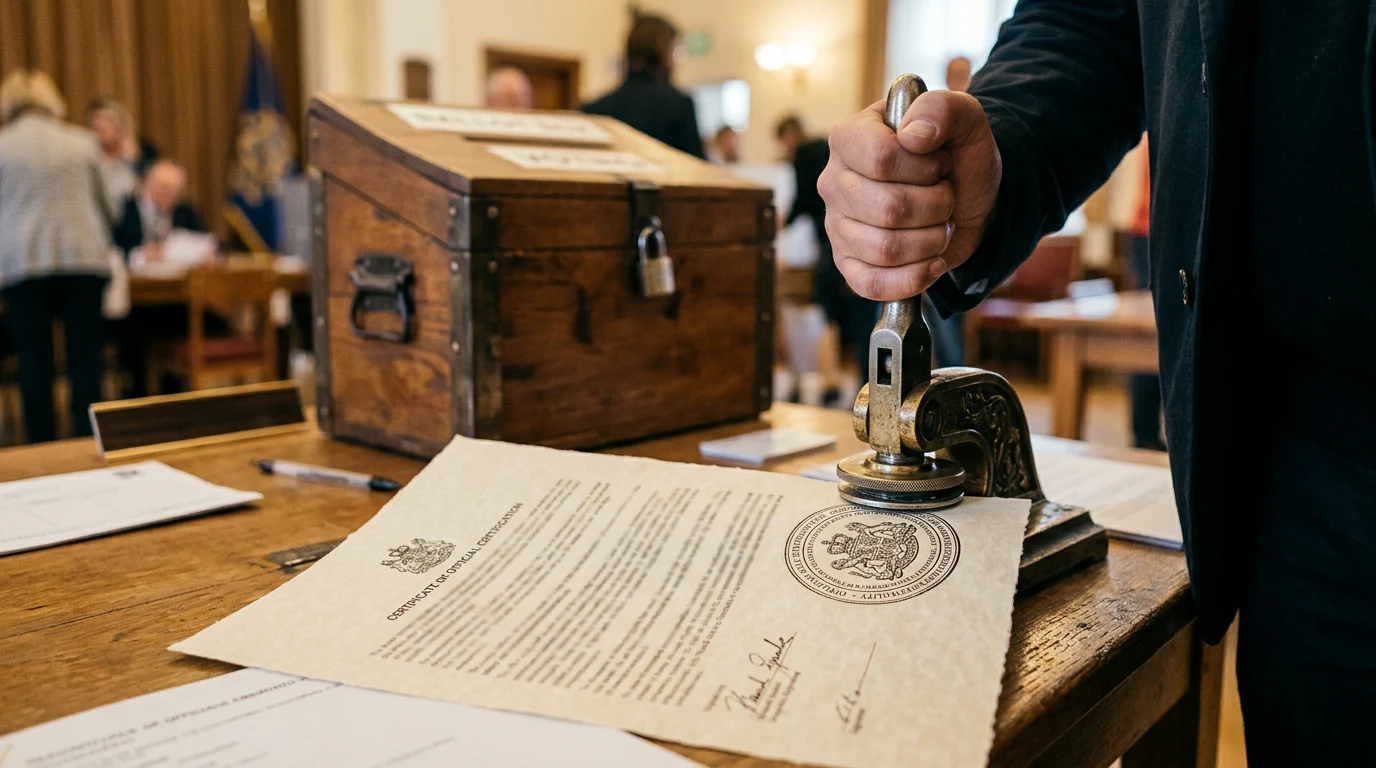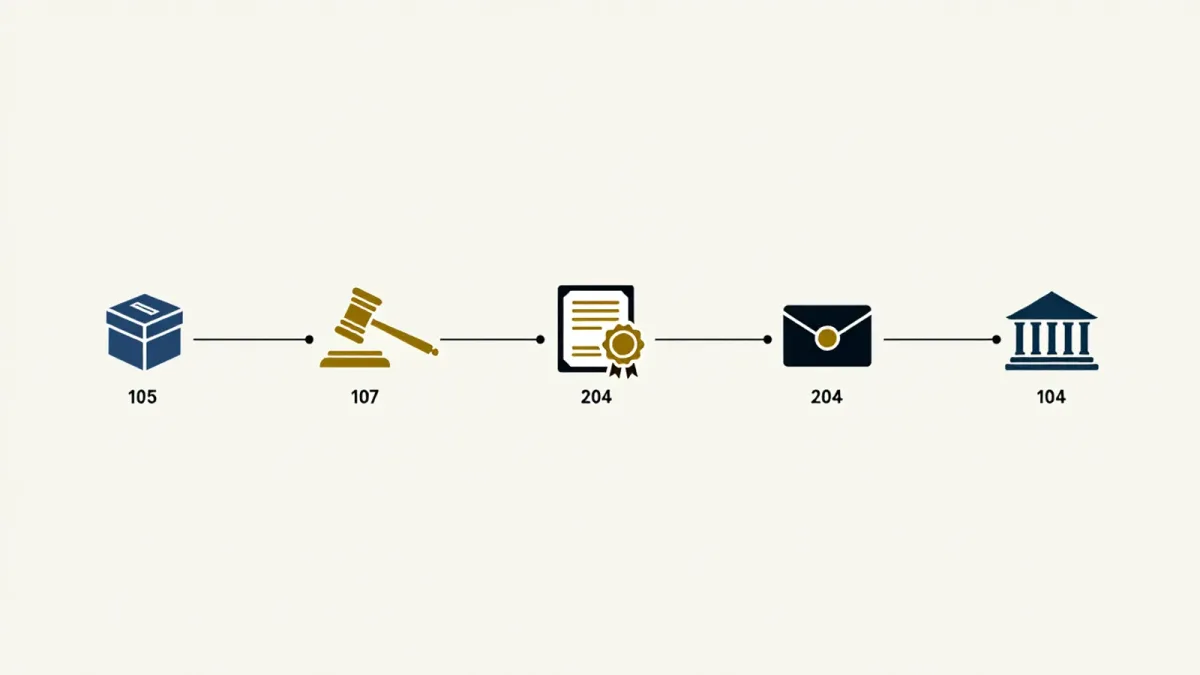
Certification is the legal step that turns counted ballots into an official result, and it runs on two stacked clocks: each state certifies its own results on a statutory schedule — generally within two to five weeks after election day — and for presidential elections the federal layer adds fixed dates under the Electoral Count Reform Act, with each state's certificate of ascertainment due at least six days before electors vote in mid-December and Congress counting the votes on January 6 of the following year. Election night totals are unofficial by definition; nothing binds until the canvassing board or certification authority signs.
What happens between election day and certification?
The administrative tail of the count, and it is long by design. County and local election offices process late-arriving mail ballots — most states count ballots postmarked by election day that arrive in the following days, with windows up to about a week — resolve provisional ballots, run reconciliation of ballot counts against voter check-in records, and complete any required tabulation audits. Military and overseas ballots under the Uniformed and Overseas Citizens Absentee Voting Act arrive during the same window. Only when those inputs close do canvassing boards — county canvass first, then a state canvass — total the results, resolve discrepancies, and certify. The canvass is a formal, documented proceeding with notice requirements, not a press conference, and its outputs are the certified returns that flow upward.
What are the state deadlines?
They vary by state and election type, but the pattern is consistent. Most states certify statewide results within about two to four weeks of election day: some small states certify local and county results within days, mid-size states certify statewide offices in the two-to-three-week range, and states with slower mail-ballot processing — California is the prominent example, with a certification deadline more than a month after election day — run longer. The dates are fixed in each state's election code, expressed either as a set number of days after the election or as an absolute calendar date. Deadlines matter most in close races because they bound the recount window: a recount must finish before certification or be folded into it, and litigation that cannot conclude by the deadline faces the same choice courts always face — order a result or accept the default.
How does the federal presidential clock work?
Under the Electoral Count Reform Act of 2022, the sequence is fixed and dated. Electors meet in each state on the first Tuesday after the second Wednesday in December — December 15 in 2026 — and cast their votes. The governor, as the state's certifying official, must issue the certificate of ascertainment identifying the electors at least six days before that meeting. Court challenges to a state's determination go to a three-judge federal panel with direct Supreme Court review on an expedited schedule, and court-ordered corrections to the certificate can follow between the six-day deadline and the count. Electors' votes are sealed and transmitted to the president of the Senate, and Congress counts them in a joint session on January 6 — January 6, 2027, for this cycle — under the reform act's rules: a ministerial count by the vice president, objections requiring one-fifth of each chamber, and no competing slates.
Who actually certifies, and can they refuse?
Boards and officers with ministerial duties, and the law has tightened on refusal. Certification is performed by county canvassing boards and state canvassing boards or their equivalents — in some states the governor and secretary of state sitting as a board — and the duty is ministerial: where the count is complete and no court order says otherwise, the board certifies the total. The 2020 cycle tested this in reverse, when a county canvassing board in Michigan initially deadlocked and withheld certification before reversing under public and legal pressure, and several states responded with legislation or court rulings confirming that a board's disagreement is not a lawful basis for withholding certification. Disputes about the count belong in recounts and contests, which have their own procedures and deadlines, not in the certification meeting itself — a principle courts enforced repeatedly in 2020 and 2022.
Why did certification become contentious at all?
Because the 2020 cycle moved the target from the count to the canvass. Before then, certification was a formality that drew no audience; after November 2020, activist pressure targeted county and state canvassing boards in Arizona, Michigan, Pennsylvania, and elsewhere, demanding delay or refusal as a means of relitigating results outside any court. The institutional response was to restate the board’s legal position: ministerial duty, court-enforced. State legislatures added provisions increasing penalties for certification refusal or clarifying timelines, secretaries of state published board guidance, and the Electoral Count Reform Act addressed the federal end of the same pressure by removing discretion from the congressional count. The lesson embedded in the current machinery is that every stage after the count is deliberately mechanical: an official’s personal view of the result has no legal slot in which to operate, and the documented record — canvass minutes, certificates, and transmittal receipts — is what courts and Congress rely on if anyone tries to create one.
What do candidates do while waiting?
Recounts and contests, each on its own clock. A recount re-counts ballots under state rules — automatic when a margin falls under a statutory threshold, discretionary on request otherwise — and must conclude by the state's certification or recount deadline. A contest challenges the outcome on legal grounds such as disenfranchisement or fraud allegations and runs in court or before the state legislature depending on the office and state. Federal races add the option of a congressional contest under the Federal Contested Elections Act, a rarely used route decided by the House or Senate after seating. The practical reality is that margins almost never change: state post-election audits and the recount record show shifts of dozens or hundreds of votes in races decided by thousands. Certification deadlines exist precisely so that the window for changing a result closes, and the machinery the reform act built — expedited federal review, dated certificates, a structured count — is the guarantee that closure now has teeth.