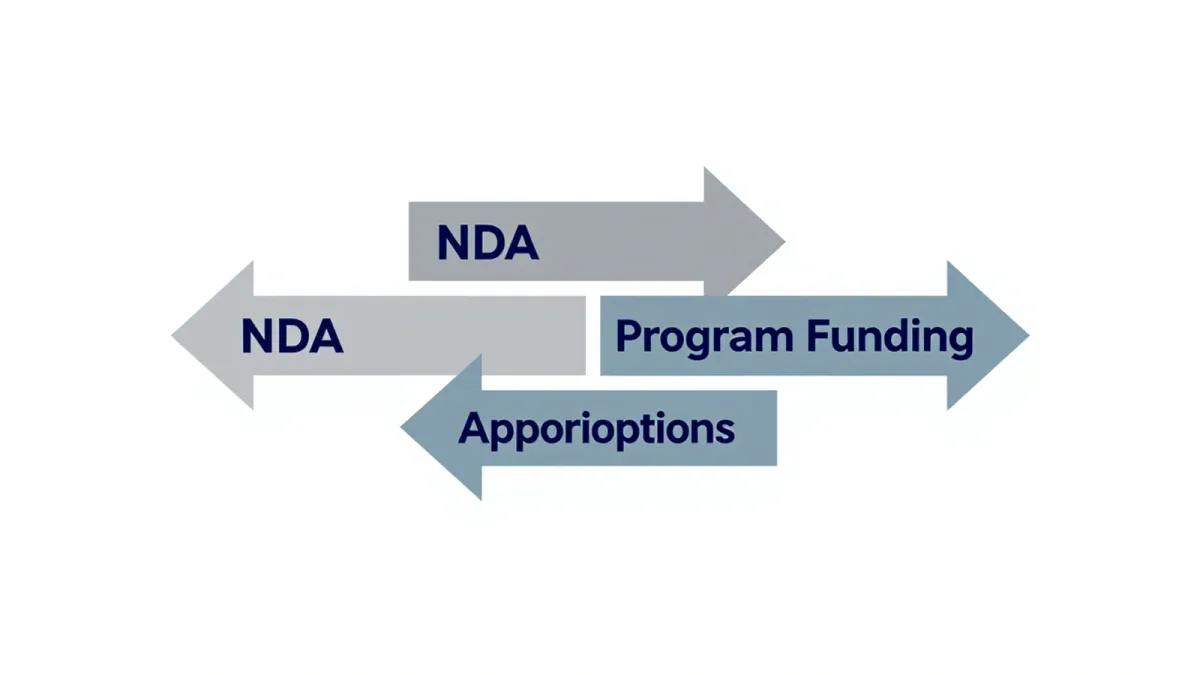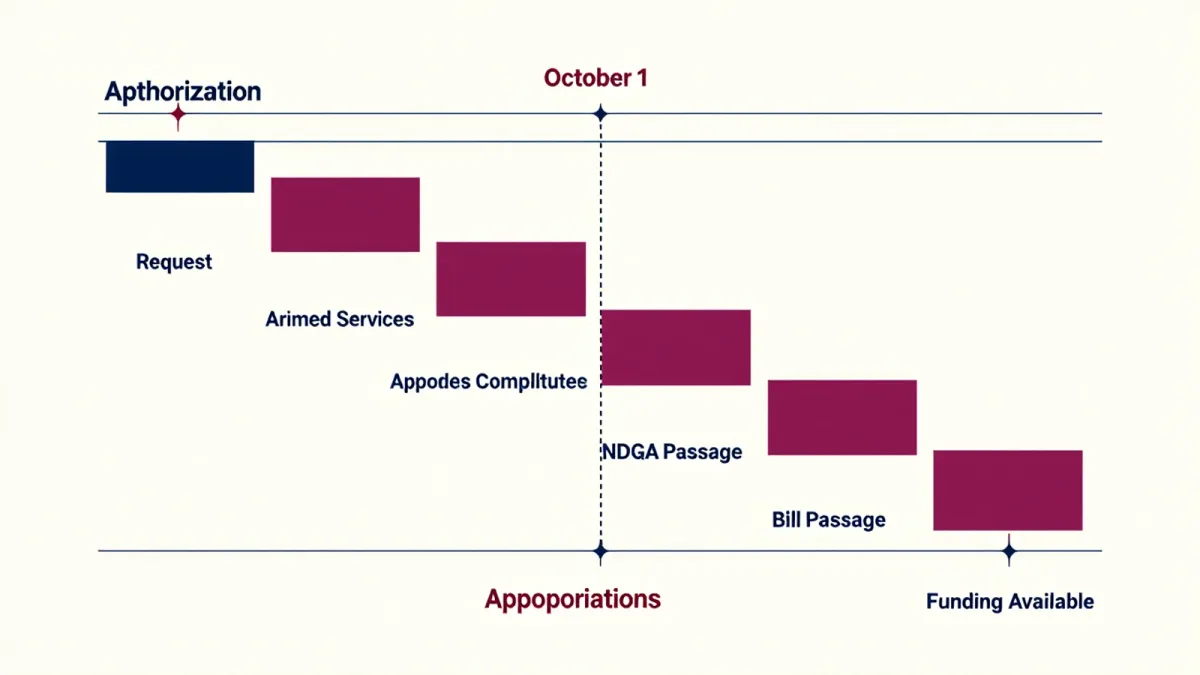
The Pentagon's "budget" is two separate acts of Congress. The annual National Defense Authorization Act — the fiscal 2025 version, signed on December 23, 2024, authorized $895.2 billion — sets policy, programs, and ceilings on what the Defense Department may do. The Defense appropriations bill provides the budget authority — the legal permission to incur obligations — and only money actually appropriated can be spent. An authorized program with no appropriation is a plan; an appropriation is the checkbook.
Understanding the split explains most budget headlines that seem contradictory: why a weapons program can be "authorized" at $3 billion while receiving less, why continuing resolutions cost real capability, and why the fiscal 2026 cycle — which included a 43-day government shutdown beginning October 1, 2025, the longest on record — matters as much as any topline. This explainer walks the machinery, drawing on Congressional Research Service budget-process reports and the bills themselves.
What does the NDAA actually do?
The NDAA is the defense policy bill, produced every year since 1961 and passed for 63 consecutive years through fiscal 2024 — the most reliable legislative product in Washington. Its functions, per CRS: authorize programs and end-strength levels, set policy directions, impose reporting and oversight requirements, and often authorize appropriations to be made — which is permission, not money. The Armed Services Committees write it; the bill routinely carries hundreds of provisions on everything from acquisition reform to Ukraine aid restrictions. The numbers in it are ceilings and policy statements. A provision "authorizing" a new destroyer does not fund one; it declares Congress's willingness to see one funded and permits an appropriation later.
What does the appropriations bill do differently?
Appropriations is where money becomes spendable. The House and Senate Appropriations Committees — through their defense subcommittees — write annual bills that provide budget authority in account-level detail: procurement, research and development, operations and maintenance, military personnel. Under the Constitution and the Anti-Deficiency Act, agencies may obligate only appropriated amounts, only for appropriated purposes, and mostly only within the fiscal year, though many defense accounts carry multi-year availability and obligation windows that stretch beyond it. Appropriators also layer their own conditions — transfer restrictions, reprogramming thresholds, report requirements — which is why the same weapons program can be authorized by one committee and shaped by another. When the fiscal year opens October 1 without a completed appropriations bill, a continuing resolution holds spending at prior-year rates with restricted flexibility — the reason CRS and defense officials consistently describe CRs as costing buying power through delayed starts and halted new programs, not just delay.
| Feature | NDAA (authorization) | Defense appropriations |
|---|---|---|
| Committees | Armed Services | Appropriations (defense subcommittee) |
| Function | Policy, programs, ceilings | Legal budget authority to obligate |
| Streak | Passed annually since 1961 | Sometimes late or under CRs |
| Spending power | None by itself | Required for any obligation |
Why does the gap matter in practice?
Three documented consequences. First, programs die in the gap: an NDAA-authorized initiative without appropriations simply does not start, which is how Congress kills programs it never votes against. Second, continuing resolutions distort decisions: services cannot start new programs, ramp production above prior-year rates, or reallocate freely, so multi-year procurement plans slip and industry absorbs uncertainty that shows up in pricing, as GAO and CRS have documented across the last decade of late bills. Third, the gap is where oversight happens twice: both committee systems amend each other's work — authorizers add conditions to appropriations, appropriators put dollar limits on authorizations — and reconciling the two is a standing negotiation that shapes weapons portfolios as much as any strategy document.
What are the arguments for keeping two bills?
The two-bill structure has defenders on process grounds: separating policy from money lets a gridlocked appropriations process proceed without freezing the policy debate, preserves two independent oversight channels — authorizers interrogate programs, appropriators interrogate accounts — and gives the minority party leverage in both. Critics, including some budget-process reformers cited in CRS work, answer that the duplication invites confusion and gaming, and biennial budgeting proposals have surfaced repeatedly in Congress without passage. The record shows no serious move to merge them; both chambers continue to treat the NDAA as must-pass policy and appropriations as must-pass money, on separate clocks.
What actually happens on October 1 without a bill?
The fiscal year starts, and one of two things occurs. With a continuing resolution, agencies operate at prior-year rates under Anti-Deficiency Act constraints: no new program starts, no production ramps above last year's rate, and the Office of Management and Budget may apportion funds in increments, adding uncertainty inside the bureaucracy. Without any CR, funding lapses and a shutdown begins. The shutdowns of 2013 and 2018-19, and the 43-day shutdown beginning October 1, 2025 — the longest on record — showed the defense pattern: military personnel continued working, often with pay timing thrown into doubt, civilian employees were furloughed, training and maintenance cycles slipped, and contractors bore uncompensated schedule risk. CRS analyses have catalogued the recurring downstream effects: delayed contract awards, deferred test events, and hiring freezes whose costs persist after funding resumes. This is the practical reason the authorization-versus-appropriation distinction matters beyond semantics: an NDAA signed in December does nothing to keep a program moving in a shutdown October, because the money bill is the only lever that touches cash.
How do the numbers relate year to year?
The two totals rarely match, and the gap is information. Authorizations can exceed what appropriators provide — leaving a program authorized but unfunded — or authorizers can cap spending below the request. Timing differs systematically: the NDAA has finished on time for decades, reaching the president's desk before the fiscal year, while appropriations has often run late, sometimes for months. Inside the money bill, the relationship between the two documents also runs backward: appropriators fund programs in account-level detail that may consolidate, split, or quietly restructure what the NDAA authorized by program name, and the services submit reprogramming requests during the year to reconcile the two. Congress's own budget resolution adds a third layer — top-line allocations that discipline both committees — and budget-control-law caps and their negotiated adjustments have shaped defense toplines for most of the past fifteen years. The practical reading habit, per CRS guidance for observers: track the authorized program list for intent, the appropriations tables for reality, and the reprogramming actions during the year for the truth about priorities as they actually adjust.
What does this change?
Reading the two budgets separately is the practical skill: authorization headlines tell you what Congress intends, appropriations lines tell you what will actually happen, and the distance between them is the honest measure of a program's support. The markers for the current cycle: whether fiscal 2026 appropriations complete within the year after the record 43-day shutdown of October-November 2025, how much of the NDAA's authorized wish list survives the money bill, and whether continuing-resolution reform proposals — long discussed in both parties — move after the shutdown's demonstrated cost. The machinery has not changed in decades; each cycle tests whether it still can.