The American defense industry consolidated from roughly 51 major aerospace and defense contractors in 1993 to five dominant primes — Lockheed Martin, RTX, Boeing, Northrop Grumman, and General Dynamics — with Pentagon policy during the post-Cold War drawdown driving much of the squeeze. The Defense Department's National Defense Industrial Strategy, published in January 2024, treats that concentration as a structural vulnerability.
This explainer traces how the consolidation happened, where it left single points of failure, and what the countermeasures on record actually do. It draws on Federal Trade Commission filings, Government Accountability Office and Congressional Research Service reports, and the Defense Department's first National Defense Industrial Strategy, published in January 2024.
How did 51 companies become 5?
The compression happened fast, and with government blessing. After the Cold War ended, defense budgets fell by roughly a third, and the Clinton administration's 1993 "Last Supper" meeting — Deputy Secretary William Perry's briefing to defense executives at the Pentagon — signaled that Washington preferred fewer, stronger firms to bankrupt primes. Lockheed merged with Martin Marietta in 1995; Boeing absorbed McDonnell Douglas in 1997; Northrop Grumman took in Grumman and later Newport News and TRW; and Raytheon and Hughes merged in 1997. By decade's end, the market structure was set. Each merger required Defense Department review, and each was approved — a policy choice, not an accident of the market, as CRS and DoD histories have documented.
Where did the single points of failure land?
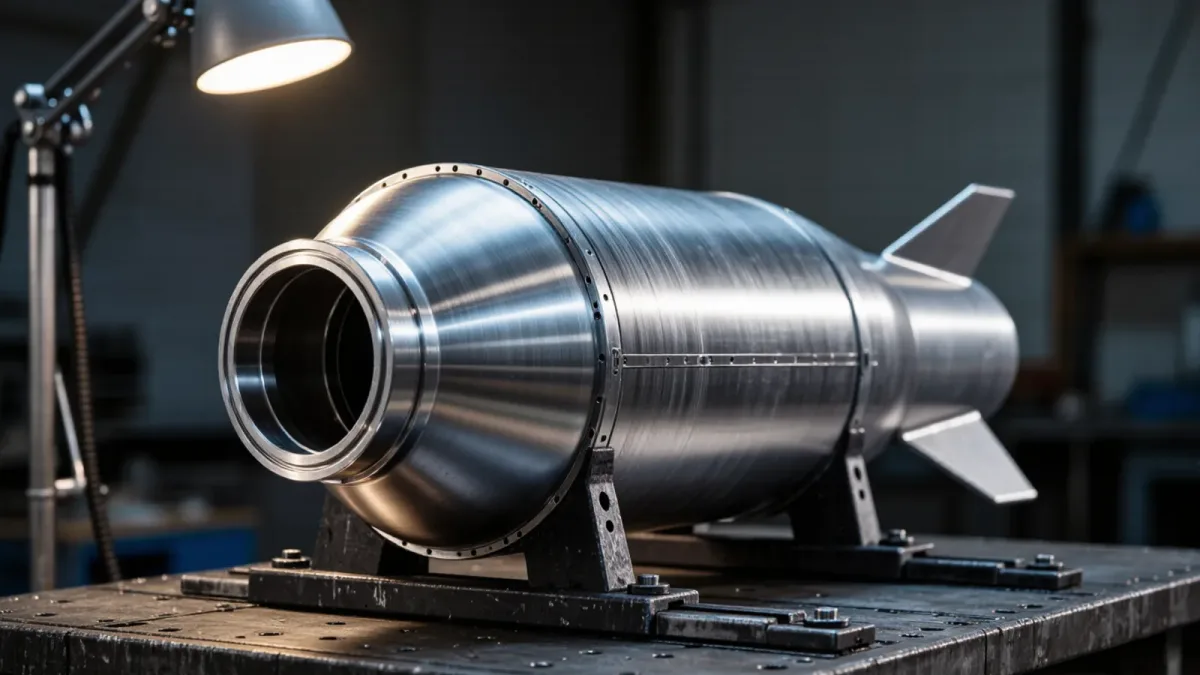
Consolidation left entire capability segments with one or two suppliers, a pattern the GAO has documented across several studies. Solid rocket motors — the engines inside most US missiles — come from two domestic producers. Nuclear aircraft carriers are built by one yard, nuclear submarines by two, both vertically tied to their prime contractors. General Dynamics Ordnance and Tactical Systems remains the sole producer of several artillery and mortar rounds. First-tier concentration matters too: GAO's 2021 work found that many critical second- and third-tier subcontractors — castings, forgings, energetic materials — had merged or exited, leaving programs exposed to single-source risk far down the supply chain. When one supplier stops, the Pentagon cannot simply switch; the Defense Production Act title III program exists precisely because market alternatives often do not exist.
What is the government doing about it now?
Three lines of countermeasure are visible in the record. First, merger enforcement: the FTC sued to block Lockheed Martin's 2021 purchase of Aerojet Rocketdyne, the last major independent propulsion maker, and Lockheed abandoned the $4.4 billion deal in February 2022 — the first defense-industry antitrust challenge in decades. Second, industrial-base investment: successive budget requests put billions of dollars into capacity for munitions, rocket motors, and shipbuilding, aimed at ramping production rates rather than changing market structure. Third, the January 2024 National Defense Industrial Strategy, which named "resilient supply chains" its first priority and called for growing new entrants, international cooperation, and stockpiling. Whether strategy documents change procurement behavior remains the open question — the Pentagon's own industrial base assessments since 2022 have continued to flag deteriorating supplier health.
| Segment | Domestic suppliers | Consequence |
|---|---|---|
| Strike fighters | Two primes | Limited head-to-head competition |
| Nuclear shipbuilding | Two yards, both prime-owned | Congestion and schedule risk |
| Solid rocket motors | Two producers | Single-source risk per program |
| Tactical missiles | Largely prime-internal | Munitions ramps depend on few lines |
What are the arguments for consolidation?
The counterargument deserves its statement: consolidation produced real efficiencies. Merged primes spread fixed research-and-development costs across larger portfolios, sustained engineering workforces through budget troughs, and gave the Pentagon fewer, more accountable prime interfaces. DoD approved the mergers in the 1990s partly because it judged smaller firms could not survive the drawdown without duplicating overhead. Defenders also note that market concentration is not the whole problem — the deeper issue, per the 2024 strategy, is that demand signals swing wildly, and no industrial structure survives thirty years of boom-bust procurement without losing suppliers. The answer for a buyer this large, on this argument, is stable multi-year contracting, not breakup.
What does the money say about competition?
Competition statistics tell the story the market structure implies. Pentagon contracting data and DoD competition reports have shown the share of contract dollars awarded competitively running well below Cold War-era norms, with a large majority of major weapons programs having no program-level competitor once a prime is selected. The competition that remains concentrates at the top of the portfolio: a handful of fighter and bomber awards — some of the largest contract decisions in government — draw bids from two primes at most, and sub-tier bidding happens largely out of public view. GAO and Pentagon acquisition reports have also documented the paradox the strategy names: new entrants are wanted, but entry barriers — facility certification, security clearances, qualification testing for energetics and castings — take years and capital that small firms struggle to raise against lumpy, uncertain demand. The policy instruments aimed at this are on the books, from other-transaction authorities to set-aside programs, but the reported trend line has moved slowly. That is the quantitative face of consolidation: the five primes are the visible edge of an industry whose competitive depth thins at every tier below them.
How does concentration show up in current programs?
The effects are visible in specific programs, not just aggregate statistics. GAO's 2024 reviews documented Virginia-class submarine deliveries running years behind contract dates, with the two-yard nuclear shipbuilding base unable to absorb simultaneous fleet requirements — a backlog that concentration built and only capacity spending can shrink. The Air Force's Sentinel intercontinental ballistic missile program breached its Nunn-McCurdy cost-growth threshold in January 2024, with the Pentagon's review citing among its causes a supplier base too thin to hold schedules. Munitions tell the same story from the demand side: after 2022, the rush to rebuild artillery, air-defense missile, and rocket inventories ran into production lines sized for peacetime, and the multi-year contracts the Pentagon subsequently awarded were designed precisely to give the surviving suppliers confidence to expand. None of these problems was caused solely by consolidation — requirements churn and budget instability share the blame — but each found its limits where suppliers had already merged or exited. That is the practical meaning of a concentrated base: every schedule risk routes through the same few gates.
What does this change?
Concentration shapes every current defense debate, even when unmentioned: Ukraine-related munitions production ramps, shipbuilding backlogs, and fighter competition all run through a five-firm funnel with thin sub-tiers. The realistic near-term changes are capacity money and slower merger approvals, not deconsolidation — no one in government has proposed dissolving the primes. The markers to watch are whether the Pentagon sustains multi-year munitions contracts long enough for sub-tier suppliers to invest, and whether any second source gets seeded in a sole-supplier segment like solid rocket motors. If neither happens, the 2024 strategy will have described the problem without changing its structure.