Guam hosts three US bases and is the only US territory within range of China's conventional ballistic missiles, and the Pentagon's answer is the Enhanced Integrated Air and Missile Defense Architecture — a planned network of roughly 20 defended sites combining Aegis Ashore batteries, new radars, and Army interceptors. Its cost estimate grew from about $1.7 billion in 2022 to roughly $8 billion by 2023, per the Government Accountability Office.
This explainer lays out what is planned, what the budget record shows, and what remains undecided. It draws on GAO reviews, Missile Defense Agency budget justifications, and Marine Corps basing documents through fiscal 2025 — the documented plans, not classified targeting or employment details.
Why does Guam matter so much?
Geography does the arguing. Guam is the only US territory inside the second island chain, about 1,500 miles from Taiwan and within range of Chinese conventional medium-range missiles, which is why defense officials call it the strategic hub of the western Pacific. The island already supports Andersen Air Force Base, Naval Base Guam with its submarine squadron, and Marine Corps Base Camp Blaz — activated in 2023 as the first new Marine base in 70 years, built to house marines relocated from Okinawa. Defense planning documents treat Guam as the anchor for US power projection in a western Pacific contingency, which makes its defenses a precondition for everything else the Indo-Pacific plans assume.
What does the defense architecture include?
The Enhanced Integrated Air and Missile Defense Architecture, run by the Missile Defense Agency with the Army, is a layered system spread across about 20 sites on the 212-square-mile island:
- Aegis Ashore batteries firing SM-3 interceptors against ballistic missiles in midcourse and SM-6 against terminal-phase and air threats — the same family of systems the Navy operates at sea.
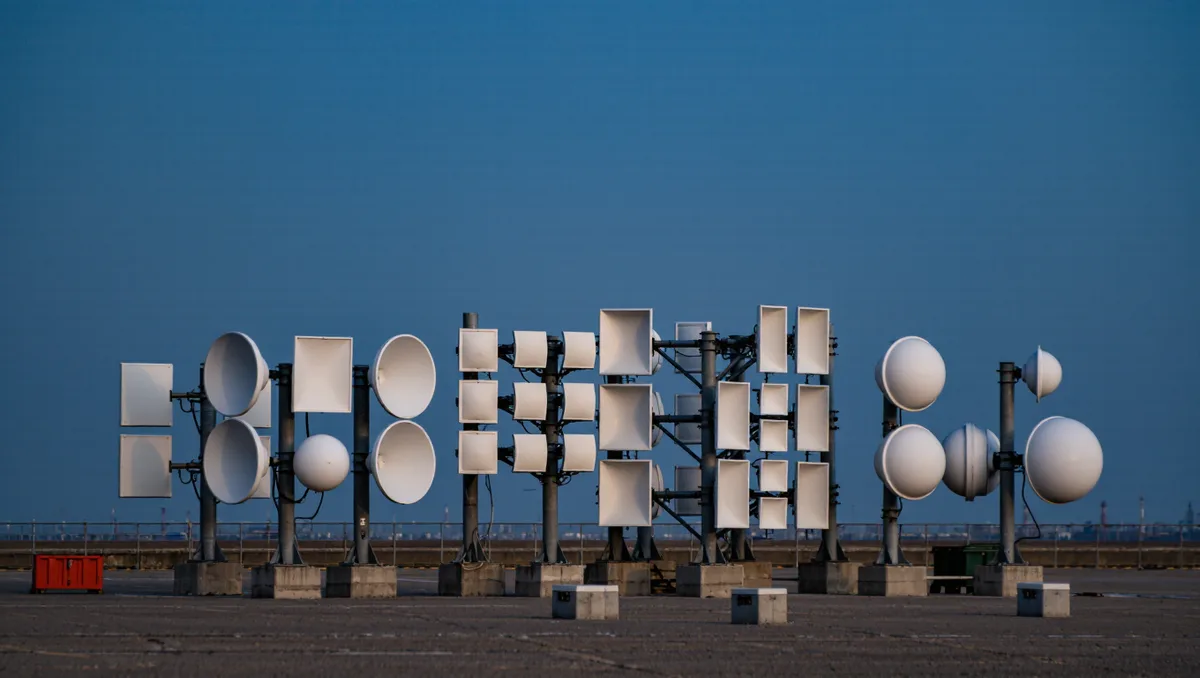
- New radars, including the LTAMDS-class sensors and fire-control radars, to replace a surveillance picture currently cobbled together from ship-based and older fixed systems.
- Army Patriot batteries and Indirect Fire Protection Capability launchers for cruise missiles and drones, the threats defense planners rate most likely in a Pacific contingency.
- A single command-and-control backbone intended to fuse all sensors and shooters — the integration problem that dominates missile defense engineering everywhere.
GAO's 2024 review documented the friction: the estimated cost roughly quadrupled from 2022 to 2023 as the scope expanded from a missile-defense patchwork into an integrated architecture, and deployment of early components slipped from mid-decade toward the end of the decade.
What is the price tag in the budget record?
Three lines dominate. The Missile Defense Agency has requested roughly $1.5 billion or more for Guam defense in each recent fiscal year, including fiscal 2025. Military construction for the Marine realignment to Camp Blaz runs in the billions, part of a two-decade, multi-billion-dollar buildup plan negotiated with Japan. And the Government Accountability Office has repeatedly flagged that the total DoD investment on the island — bases, ports, ranges, and now missile defense — is accumulating faster than any single budget line communicates, which is precisely what its consolidation-of-buildup reviews track. Congress has so far funded the program, with appropriators questioning cost growth in every cycle since 2023.
What are the open questions?
Three, on the record. Cost trajectory: whether the $8 billion estimate holds as land acquisition, cultural and environmental reviews with the Chamorro community, and construction costs in a remote Pacific location work through the program. Capacity: GAO has questioned whether the 20-site plan provides genuine operational resilience or concentrates risk in shared utilities and logistics. And the counterargument deserves its statement: some defense analysts, cited in congressional research, argue that fixed defenses on one island are inherently target-rich and that dispersal across the Pacific would buy more resilience per dollar. The Pentagon's answer so far is that Guam cannot be relocated — its anchor role makes layered defense mandatory regardless of the debate.
What else is the US building on the island?
The missile defense network sits inside a broader buildup that predates it and constrains it. Camp Blaz's construction, begun in the 2010s and activated in 2023, relocates thousands of marines from Okinawa under a US-Japan agreement funded partly by Japanese contributions. The Navy has modernized its Apra Harbor wharves to support submarine and surface ship maintenance, and the Air Force continues to operate Andersen as its main Pacific bomber rotation hub, with diversion airfields on nearby Tinian receiving new investment under the Pacific Deterrence Initiative. Every one of these projects competes for the same island constraints that the missile defense program's critics cite: limited usable land, port and airfield capacity, power and water utilities, and a local community whose consent the Defense Department is legally obligated to seek through cultural, environmental, and land-acquisition reviews. GAO's buildup reports have made the interaction explicit — base construction schedules and defense-architecture sites draw on the same construction labor pool, which is one documented driver of the cost growth. The perimeter, in other words, is not a stand-alone project; it is the newest layer of a two-decade accumulation whose infrastructure assumptions were set before the missile defense requirement existed.
How did the schedule move?
The deployment timeline is the program's most telling scorecard. Early plans in the early 2020s pointed to initial defensive capability in the middle of the decade; GAO's reviews recorded slippage as the architecture grew — environmental and land-acquisition work expanded across more sites, and early radar and launcher deliveries shifted toward the end of the decade, with the full architecture stretching into the 2030s. The causes the public record names are the island's realities: cultural and historic-preservation consultation, land acquisition on a small territory where usable parcels are scarce, and the shared construction market with the Camp Blaz buildup. The Missile Defense Agency's responses have included splitting the program into deliverable increments — early terminal defenses fielded first, midcourse and cruise-missile layers later — so some capability lands even as the complete network waits. For defense planners the schedule matters strategically: the architecture is explicitly meant to be in place before the threat it faces matures, which is why every year of slippage draws congressional attention out of proportion to its budget line.
What does this change?
Guam is the first place the United States is building a permanent, island-scale integrated air and missile defense, and its choices will template the region: the same radar families, interceptor mixes, and command-and-control backbone are the reference design for Philippine, Japanese, and Australian deployments under discussion. The markers to watch are the annual Missile Defense Agency budget lines for Guam, whether early Aegis Ashore deliveries land on the revised schedule, and whether Congress caps the program as costs compound. Until then, the honest summary of the Guam perimeter is: defined, funded year by year, and unfinished.