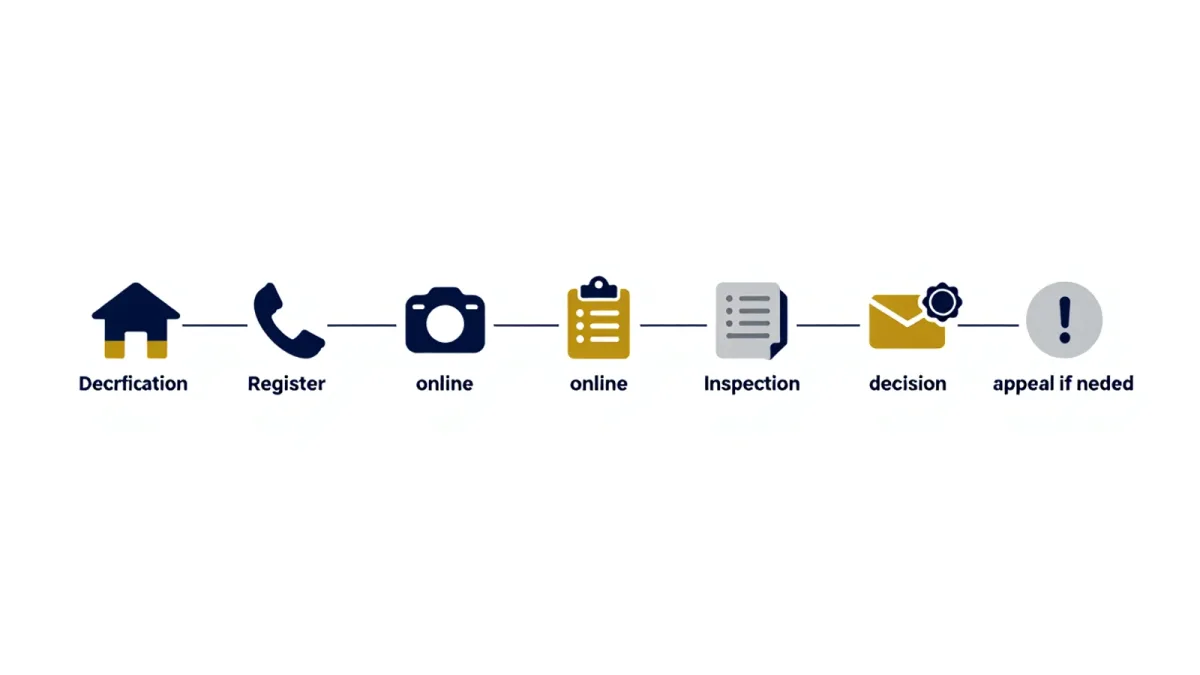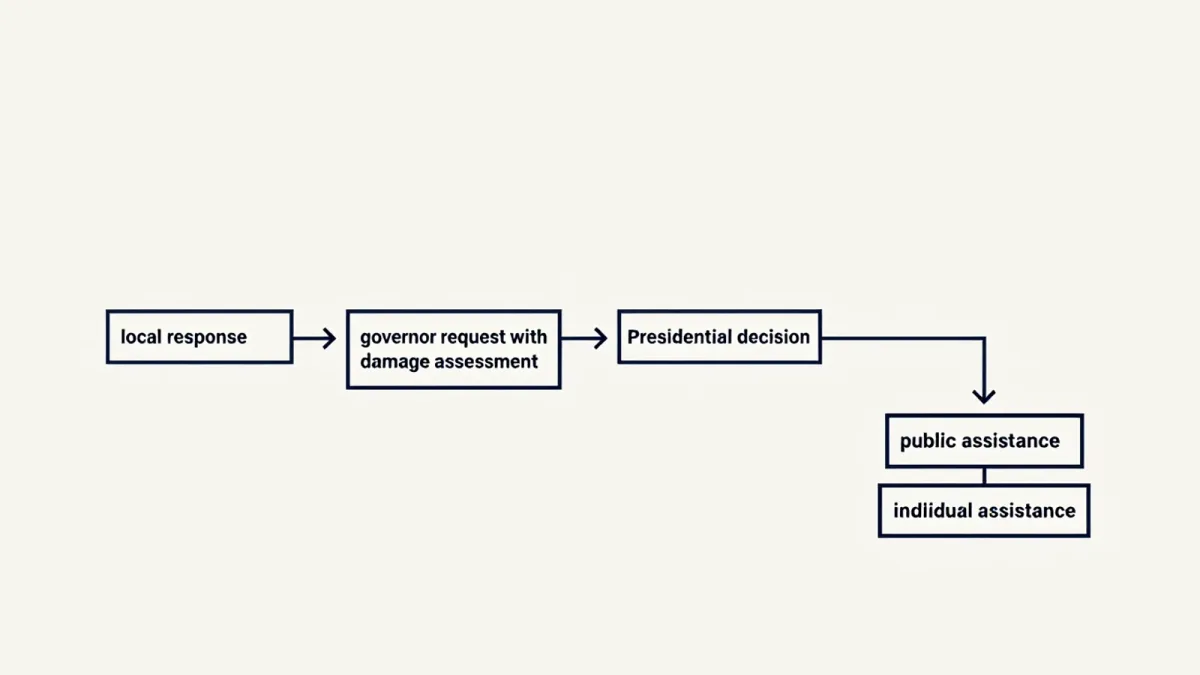
A state gets a federal disaster declaration through a sequence fixed by the Stafford Act of 1988: the governor requests it, certifying that state resources are exhausted; joint federal-state teams assess the damage; FEMA evaluates the request against published indicators; the president decides. FEMA recorded 79 major disaster declarations in 2020, the highest annual count on record.
The joint preliminary damage assessment is the evidentiary core of that file, and its quality decides how the request reads upstairs. The declaration is the gateway to every downstream federal dollar: public assistance reimbursing governments for debris removal and infrastructure repair, individual assistance paying homeowners and renters directly, hazard mitigation funding for future risk reduction, and in emergencies, direct federal help protecting lives. The pipeline looks mechanical and is not entirely — the statutory indicators are advisory, the president holds unreviewable discretion, and research on declaration decisions has consistently found political variables alongside the damage counts. Understanding both layers explains why two storms of similar destructiveness can produce different outcomes.
What starts the process?
The response begins locally by law: FEMA's doctrine assigns the first responders to local and state government, and federal help activates only when the state asks. Once damage exceeds what the state can handle, the governor requests a joint preliminary damage assessment, in which FEMA regional staff and state officials together survey affected areas and classify damage to homes, businesses, and public infrastructure. The governor then formally requests a presidential declaration, and the Stafford Act requires the governor to certify that the situation exceeds state and local capability and that the state has committed its own resources — including, where applicable, an indication of whether the state will commit matching funds. The request package, with the joint assessment data, goes to the FEMA regional office and then to headquarters for evaluation.
What thresholds does FEMA apply?
FEMA's regulations publish numeric indicators, but with an explicit caveat that they are not binding. The standing indicator for public assistance has historically been state-level damage of a dollar amount per capita — a threshold set at one dollar per capita in the 1980s and adjusted annually for inflation, plus a statewide per-capita indicator for individual assistance that is higher. FEMA's own published evaluations have acknowledged that many approved requests fell short of the indicators and some denials exceeded them, which is why the factors beyond the numbers matter. Those include localized concentration of severe damage, insurance coverage levels, recent disaster history, and hazard mitigation opportunity. Researchers at GWU and elsewhere who have compiled declaration datasets report that the probability of approval correlates with damage severity and also with congressional representation and timing in the election cycle — findings that FEMA and successive administrations have not disputed as description.
What is the difference between an emergency and a major disaster declaration?
The Stafford Act creates two instruments. An emergency declaration, the narrower tool, authorizes federal help to save lives and protect property — often used before an anticipated event, as with pandemic and hurricane landfall declarations, and limited to emergency-type assistance. A major disaster declaration, the broader one, unlocks the full apparatus: public assistance for state, local, tribal, and certain nonprofit applicants; individual assistance for affected households; and hazard mitigation set-asides statewide. The president may declare both at once or sequence them. The choice determines which cost-sharing formulas apply — federal public assistance typically covers at least 75 percent of eligible costs, with presidential discretion to raise the federal share after severe events.
How does the money actually flow after a declaration?
Through reimbursement, not lump sums. Public assistance applicants document eligible work — debris removal, emergency protective measures, permanent restoration of public facilities — and are paid against validated costs, with FEMA administering the program through its regional offices and a grants infrastructure that GAO has repeatedly criticized for slow processing and improper-payment risk. Individual assistance pays registered applicants directly for essential repairs, temporary housing, and other serious needs, capped at annual maximums FEMA adjusts. Mitigation funds flow through state programs under the Hazard Mitigation Grant Program. The common thread is documentation: the declaration is the entrance, but every dollar after it requires paperwork that, in slow disaster years as in busy ones, takes applicants months to years to collect.
What role do tribes and territories have?
The same pipeline, with a structural change from 2013: the Sandy Recovery Improvement Act allowed federally recognized Indian tribal governments to request declarations directly from the president, bypassing the governor step and dealing with FEMA as sovereign applicants. Before that, tribal damage ran through the state's request, a channel many tribal leaders described as unreliable. Territories operate through their governors like states, with their own regional office relationships. The reform's stated purpose was to speed assistance to tribal lands after severe events, and FEMA's published guidance now treats tribal governments as distinct applicants with their own damage thresholds — a small procedural change with a large practical effect for the roughly 570-plus federally recognized tribes as of the mid-2020s.
What does this change?
The declaration count is the quiet index of federal disaster policy: as the annual number has climbed toward and past previous records — 2020's 79 far exceeds the totals of the 1980s, when the Stafford Act was new — the fiscal stakes of each request and each indicator adjustment have grown with it. Proposals to raise thresholds, shift more cost to states, or reform the damage-assessment process recur in every Congress. For a state or county watching a storm approach, the practical calculus is unchanged since 1988: document damage fast, file the governor's certification cleanly, and know that the published thresholds are a floor for the conversation, not a guarantee — because the final word belongs to a signature that statute places above review. That is the process in one sentence: objective damage data opens the file, and a discretionary signature closes it — which is why the paperwork discipline of the first week matters as much as the politics of the last one.