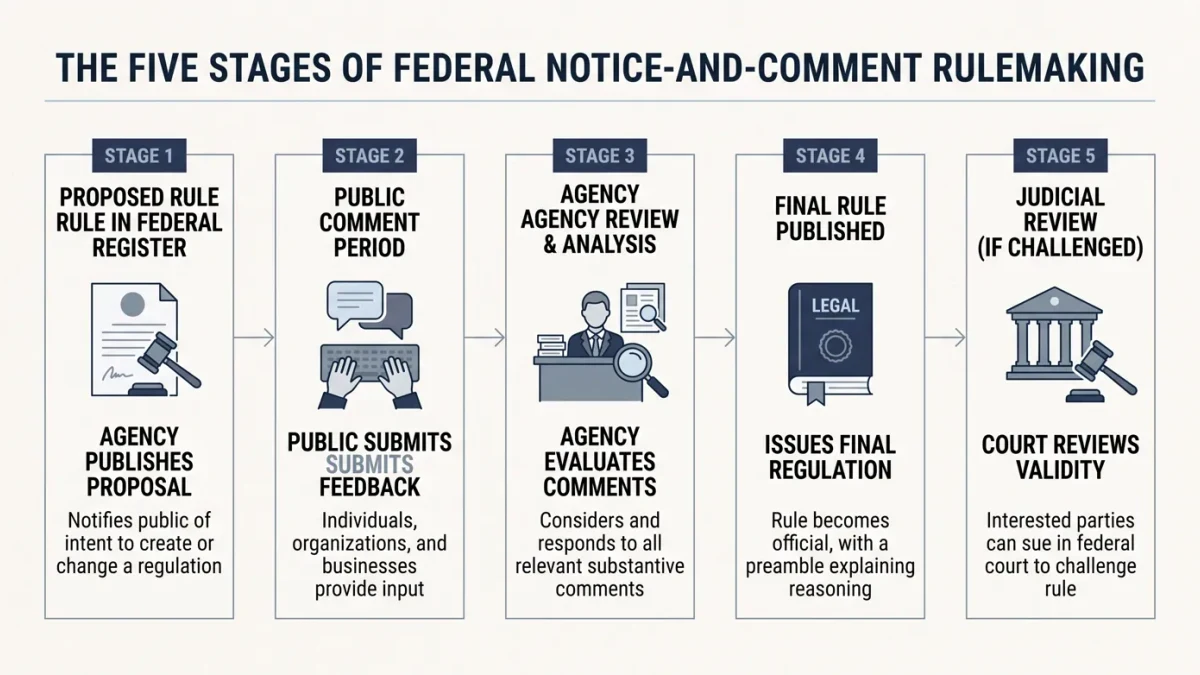
A federal agency writes a rule through a fixed sequence set by the Administrative Procedure Act of 1946: draft a proposal, publish it in the Federal Register for public comment — 60 days is common — then issue a final rule effective no sooner than 30 days after publication. The Federal Register logged over 60,000 pages in fiscal 2024.
The statute Congress passes states goals, not engineering. It says the Environmental Protection Agency shall set air quality standards protecting public health, or that the Department of Labor shall define hazard pay — and the agency's regulations fill in the thresholds, forms, and deadlines that make the law enforceable. This explainer follows one rule from statutory mandate to Federal Register citation, using the procedures codified at 5 U.S.C. 553 and the executive-order review process that has governed significant rules since 1993. This publication covers the machinery as reporting, not as legal advice.
Where does a rule come from?
Most rules begin as a statutory directive: Congress orders an agency to regulate something and sets a deadline, or the agency itself decides an existing mandate needs updating. The agency's career staff develop the technical work — exposure data, cost estimates, compliance models — into a draft. Before anything is public, the draft crosses two internal gates. First, the agency's own general counsel checks procedural authority. Second, for any rule the Office of Management and Budget designates significant — generally those with at least $100 million in annual economic effects, under Executive Order 12866, issued in 1993 — the Office of Information and Regulatory Affairs reviews the draft and its cost-benefit analysis, sometimes for months. Outside interests can shape the draft here too: OIRA logs the meetings, but a rule that emerges from review often differs from the version the agency's economists first circulated.
What happens when the proposal goes public?
The proposed rule, or Notice of Proposed Rulemaking, appears in the Federal Register with a preamble explaining the agency's reasoning and a docket number. Simultaneously, the full supporting materials — studies, data, economic analysis — go up on regulations.gov, the government's centralized docket site. From that day, any person or organization can submit a comment. Comment periods commonly run 30 to 60 days; complex rules draw hundreds of thousands of submissions, and high-profile ones have drawn millions, many generated by coordinated campaigns. Agencies must read and consider every distinct argument. They are not required to agree with commenters, but under the APA they must respond to significant, relevant points in the final rule's preamble — and a court can vacate a rule that ignores them.
Can the process be skipped?
Yes, narrowly. The APA's notice-and-comment requirement under 5 U.S.C. 553 carries an exemption for "good cause," invoked when delay would defeat the purpose of the action, and it excludes interpretive rules that merely explain existing regulations rather than impose new obligations. Agencies overusing these escape hatches have paid for it: courts routinely strike rules that dressed up substantive policy as interpretation. Congress added another check in 1996 with the Congressional Review Act, which lets Congress void a recently issued rule by joint resolution — a tool used rarely for decades, then repeatedly in 2017 and again in 2021 to unwind rules issued in a departing administration's final months.
What does the final rule have to contain?
The final rule restates the agency's decision in enforceable regulatory text, codified in the Code of Federal Regulations, and its preamble must do three things the APA demands: respond to major comments, explain any change from the proposal, and show the agency considered the alternatives in its analysis. If the comment record exposed a flaw in the cost estimates, the final rule recalculates them. If the agency changed course, it must say why — and when a change is significant, the safest procedural route is a new proposal and a second comment round, which is one reason rulemaking so often runs for years.
Who can still stop a rule?
Four levers remain after publication. Congress can disapprove the rule under the Congressional Review Act, generally within 60 legislative days. OIRA can press for revision before signature, and its "return letters" have quietly redirected many significant rules. Litigation is the most common: challengers argue the agency exceeded its statutory authority or acted arbitrarily under the APA, and the cases can take years — final rules from one administration are frequently still in court when the next one begins rewriting them. And a new president can direct the agency to propose a replacement, which restarts the entire pipeline, because an existing rule can only be undone through the same procedures that created it. Venue matters too: challengers file in a district court of their choosing within statutory limits, and 28 U.S.C. 2112 requires that challenges to the same rule be consolidated before one court — which is why parties race to file first in circuits they view as favorable.
Why does this machinery matter?
Because nearly every consequential federal policy that does not name a person, set a tax rate, or appropriate money arrives as a regulation, and the rulemaking pipeline is where its actual terms get decided — the emission number, the overtime threshold, the visa category definition. The procedural record also becomes the litigation record: under longstanding administrative law doctrine, courts reviewing a rule generally look to the reasoning in the preamble, not the agency's after-the-fact explanations. A rule built carefully through the comment process survives challenge more often than one pushed through quickly. For anyone tracking federal policy, the practical tells are the docket — comment volume and the identity of major commenters Written answers, called questions for the record, can extend that scrutiny for months after a hearing closes. — Written answers, called questions for the record, extend that scrutiny for months after the hearing itself. the OIRA meeting logs, and the gap between proposal and final text. That gap is where the lobbying, the data, and the compromises that shape the final regulation actually live.