Birthright citizenship under the 14th Amendment has been settled constitutional doctrine since United States v. Wong Kim Ark in 1898, which held that a child born in the United States to non-citizen parents is a citizen by birth. The live disputes in 2026 are different ones: after an executive order in January 2025 tried to deny citizenship to children of certain non-citizens, federal courts blocked it, and in Trump v. CASA on June 27, 2025 the Supreme Court limited nationwide injunctions — moving the fight onto class actions and state suits rather than ending it.
USA Daily News 24 is an online publication, not a law firm, and it publishes information, not legal advice. Families and practitioners facing a citizenship question in a specific case should rely on licensed counsel and official agency guidance.
Where did the rule come from?
It is a post-Civil War construction. The Civil Rights Act of 1866 first declared persons born on American soil, not subject to foreign power, to be citizens; the 14th Amendment, ratified two years later, wrote the rule into the Constitution so it could not be repealed by a future Congress. Dred Scott v. Sandford in 1857 had denied citizenship to Black Americans entirely, and the amendment was designed to bury that reasoning. Wong Kim Ark then applied the clause to children of non-citizens in 1898 over a dissent that read the clause more narrowly.
What does the 14th Amendment actually say?
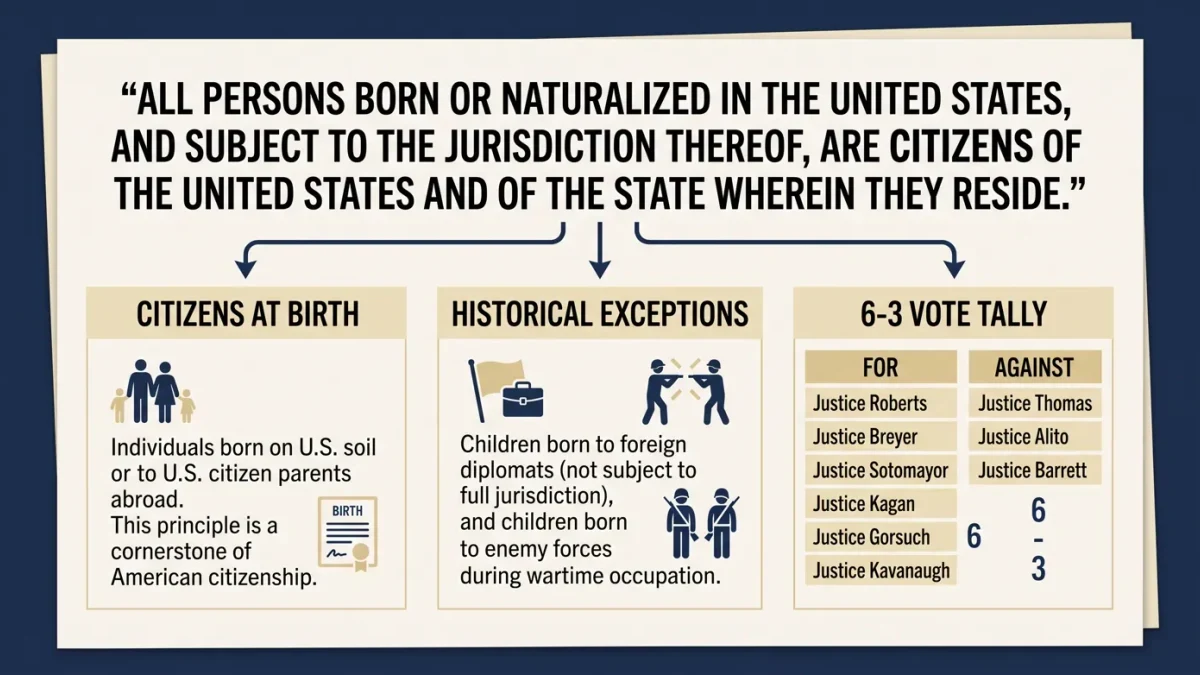
Section 1 of the amendment, ratified in 1868, provides that all persons born or naturalized in the United States, and subject to the jurisdiction thereof, are citizens of the United States and of the state where they reside. The phrase "subject to the jurisdiction" is the hinge of every dispute. In Wong Kim Ark, the Supreme Court read it to exclude only a narrow set of cases — children of foreign diplomats and of hostile occupying forces, and children born to members of tribes not taxed at the time. Everyone else born on American soil, the Court held, is a citizen, overruling the earlier Dred Scott reading of the clause. Congress extended the same rule by statute in the Immigration and Nationality Act of 1952, Section 301(a).
What happened in 2025?
On January 20, 2025, an executive order directed federal agencies to stop recognizing citizenship at birth for children whose mothers were unlawfully present or temporarily in the country and whose fathers were not citizens or lawful permanent residents. Within days, federal judges in Washington state and Maryland blocked the order: Judge John Coughenour in Seattle issued a temporary restraining order on January 23, 2025, calling the question a slam-dunk against the government, and Judge Deborah Boardman in Maryland entered a nationwide preliminary injunction in February 2025, which the Fourth Circuit declined to stay. The government's appeals produced .
What did Trump v. CASA change?
The Supreme Court's June 27, 2025 decision in Trump v. CASA did not touch the merits of birthright citizenship at all. It held that federal district courts probably lack the equitable authority to issue universal injunctions — orders barring enforcement of a policy against anyone, anywhere — and narrowed the injunctions against the citizenship order to the plaintiffs before each court. Justice Amy Coney Barrett wrote for the majority; the Court noted that states and class actions remain available vehicles for broader relief. Within a month, that is exactly what happened: a class action in New Hampshire produced a class-wide injunction in July 2025 from Judge Joseph Laplante covering children who would be affected nationwide, and a multi-state suit continued on a separate track. The citizenship order itself remained blocked from taking effect as of mid-2026, while the merits litigation moved through the courts.
Which arguments define the merits fight?
Litigation over the order's application has moved through at least four federal districts and two courts of appeals. The government's position in the 2025 litigation was that "subject to the jurisdiction" means full and complete allegiance, so children of undocumented or temporarily present parents are excluded. The countervailing textual and historical record runs the other way: the phrase's drafters tied it to legal jurisdiction rather than allegiance, the Wong Kim Ark majority treated allegiance arguments as discredited, and a century of executive practice — passports, census counts, military service — recognized citizenship at birth for these children. The Solicitor General defended the order in the lower courts while simultaneously relying on the Supreme Court to shrink the injunctions, which succeeded in reframing the procedural terrain without changing the underlying doctrine. No Supreme Court merits ruling on the order had issued as of mid-2026.
Who is actually affected while the litigation runs?
The order would have applied, on its terms, to children born on or after February 19, 2025 whose mothers were unlawfully present or temporarily present and whose fathers were neither citizens nor lawful permanent residents. Because the order never took effect, agencies continued issuing citizenship documentation as before, and the affected cohort is defined by what would have happened rather than what did. But the uncertainty is itself an effect: hospitals, state registrars, and families have tracked the docket because a reversal on the merits would apply going forward and leave a generation of paperwork in question.
What does this change?
Three things follow from the line as it stands. First, the constitutional rule of Wong Kim Ark remains the law every lower court applied in 2025, and children born on American soil are documented as citizens by the agencies until any contrary ruling binds them. Second, the era of one district judge pausing a federal policy nationwide is curtailed; challenges to national policies now arrive as class actions and state coalitions, which changes the timing, venue, and appeal paths of every rights dispute, not just this one. Third, the stakes of the pending merits cases are concrete: citizenship determines passport eligibility, state and federal benefits, and eventual voting rights, so whichever court first reaches the merits under the new procedural rules will effectively set the boundary for the amendment's second sentence for a generation.