Immigration detention is civil, not punitive, but it is still detention, and the Supreme Court has set a working limit: under Zadvydas v. Davis from 2001, the government may generally hold a deportable non-citizen no more than six months beyond the removal period before the detainee can demand evidence of a realistic prospect of removal. The safeguards around that limit — bond hearings, access to counsel, judicial review — have been cut back by a series of 5-4 decisions since 2018, even as the 2025 wave of erroneous deportations pushed due process back to the center of the debate.
Detainees and their families should consult an immigration attorney or an accredited representative, because custody rules turn on case-specific statutory categories.
What is the six-month rule in Zadvydas?
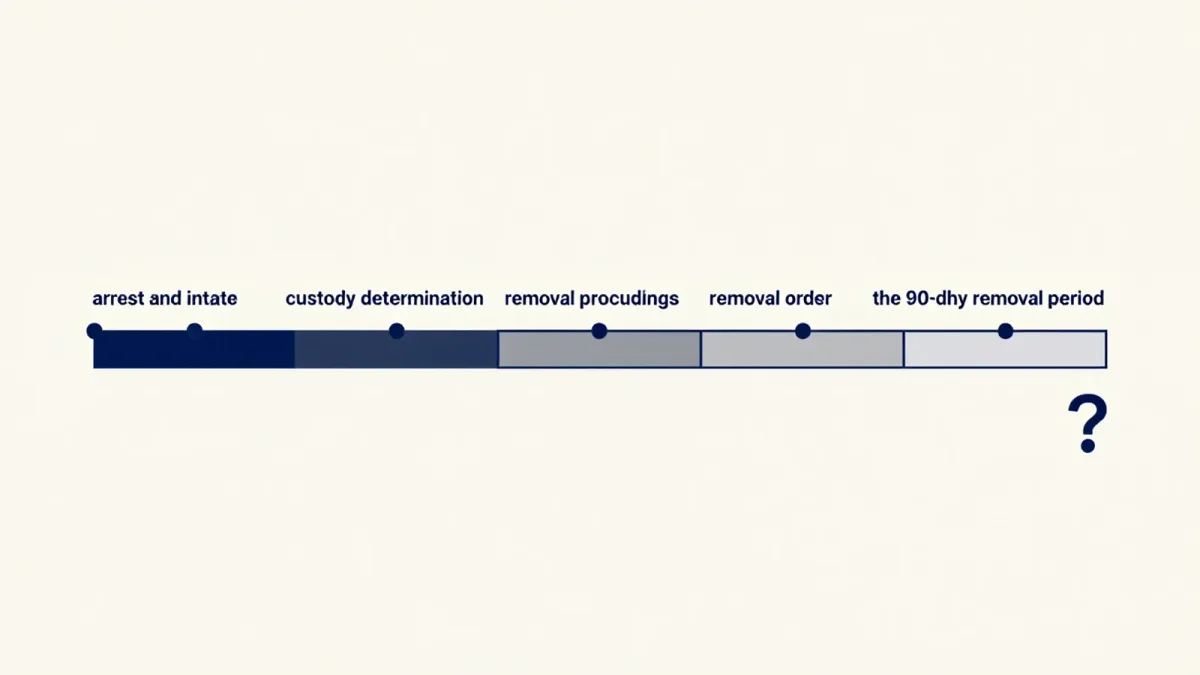
Two men — Kestutis Zadvydas and Kim Ho Ma — were ordered deported to countries that would not take them, and they remained in custody indefinitely after the 90-day statutory removal period expired. The Supreme Court held in 2001 that a statute permitting detention beyond that period must be read to avoid serious constitutional problems, and so it contains an implicit reasonable period, presumptively six months. After that, the detainee is released unless the government provides evidence of a significant likelihood of removal in the reasonably foreseeable future. The decision governs post-order detention; it does not limit detention while removal proceedings are pending, which is governed by different provisions of the detention statute and by mandatory-detention rules for certain criminal categories.
Which constitutional rights carry into civil custody?
The Supreme Court established in 1886 — in Yick Wo v. Hopkins — that non-citizens present in the United States are "persons" under the Fifth and Fourteenth Amendments, and subsequent cases confirm that someone facing removal is entitled to notice, a hearing, and a decision by an immigration judge. What due process requires in that hearing is calibrated by Mathews v. Eldridge, the 1976 balancing test weighing the private interest, the risk of error, and the government's burden. The fight in detention cases is rarely over whether the right exists; it is over how much process the civil setting requires, and at what point duration converts lawful custody into something the Constitution will no longer countenance.
Do detainees have a right to a bond hearing?
The Court said no, as a matter of statute. In Jennings v. Rodriguez in 2018, a detained non-citizen challenged the absence of periodic bond hearings during prolonged detention. The Court, in an opinion by Justice Alito, held that the immigration statutes contain no such requirement, leaving the constitutional question open and remanding. The Ninth Circuit had imposed six-month bond hearings; the Supreme Court rejected that reading. Lower courts continue to litigate prolonged-detention claims under the Constitution rather than the statute, and some circuits require bond hearings for detentions that stretch past a year or more, but there is no nationwide constitutional rule as of mid-2026.
How far does judicial review reach?
Two decisions define the limits. In Garland v. Aleman Gonzalez in 2022, the Court held that a class of detained non-citizens could not use a general cause of action to challenge fast-track removal procedures, because a specific jurisdiction-stripping provision barred such suits. And in INS v. Lopez-Mendoza from 1985, the Court held that deportation is a civil proceeding in which the exclusionary rule generally does not apply, so evidence gathered through unlawful arrest usually still supports removal. What remains is ordinary judicial review of removal orders and habeas corpus review of custody itself — the avenue the Court left intact in Zadvydas and in its 2021 decision in Jiad v. ICE, which addressed when a changed custody status makes a detention challenge moot.
What about access to counsel and interpreters?
There is no Sixth Amendment right to appointed counsel in removal proceedings, because they are civil; detainees may retain counsel at their own expense, and the government funds a limited legal orientation program. Regulations require interpretation services in proceedings, and detention standards set phone access for attorney contact. Practitioner reports and court findings have repeatedly documented gaps between those standards and facility practice, and litigation over government-funded legal representation for detained children — litigated under the 2008 anti-trafficking reauthorization and the Flores settlement line — continues to define the floor for the most vulnerable detainees.
Why did 2025 put this back in the headlines?
The machinery collided with speed. The case of Kilmar Abrego Garcia, a Maryland construction worker erroneously deported to El Salvador in March 2025 despite a court order withholding his removal, produced a unanimous Supreme Court decision on April 10, 2025 directing the government to facilitate his return, with the Court noting the government's acknowledgment of an error. Separately, in Noem v. Vasquez Perdomo in May 2025, the Court allowed Los Angeles-area enforcement sweeps to continue while litigation proceeded, over a sharp dissent from Justice Sotomayor warning that individuals were being seized without individualized suspicion. Neither ruling decided the merits of due process claims, but both framed the 2025-2026 litigation: what process is owed before removal is executed, and what the government must do when it removes the wrong person.
What does this change in practice?
As of mid-2026 the operative framework is: mandatory detention for criminal and security categories without statutory bond; six months as the presumptive limit for post-order detention of removable non-citizens no country will accept; no federally guaranteed periodic bond hearing during pendency; exclusionary-rule protections largely unavailable in removal proceedings; and habeas corpus as the channel for custody challenges, with Section 1252(g) blocking some class-wide procedural suits. The 2025 cases added a practical corollary — courts will order the government to remedy erroneous removals, but the burden of proving the error and securing process falls on the detainee's counsel, which is why access to legal representation, not any single holding, remains the decisive variable in whether due process actually happens on the timeline the Constitution presupposes.