Qualified immunity is a judicial doctrine that shields government officials, including police officers, from civil liability unless they violated a constitutional right that was already "clearly established" by prior case law when they acted. The Supreme Court created the modern version in Harlow v. Fitzgerald in 1982, and federal courts have dismissed a large share of Section 1983 lawsuits at that threshold ever since.
Where did qualified immunity come from?
The doctrine grew out of 42 U.S.C. Section 1983, an 1871 civil rights statute that lets people sue state and local officials for constitutional violations. In Pierson v. Ray in 1967, the Supreme Court held that officers could defend themselves with a good-faith defense. By Harlow v. Fitzgerald in 1982, the Court had reshaped that defense into an objective test: an official loses immunity only if the right at issue was clearly established, so that a reasonable official would know the conduct was unlawful. The Court's stated goal was to spare officials from the burden of trial and discovery in gray areas.
How do courts actually apply it?
Most federal circuits run a two-step analysis, first described in Saucier v. Katz in 2001. Step one asks whether the facts show a constitutional violation. Step two asks whether the right was clearly established at the time. In Pearson v. Callahan in 2009, the Court made the sequence optional, letting judges skip straight to step two. That skip matters: when a court decides a case purely on the clearly-established question, the underlying violation is never adjudicated, and the ruling creates no new precedent to guide future conduct or future plaintiffs.
What counts as "clearly established" is deliberately narrow. The Court has said the precedent must place the unlawfulness "beyond debate." In Kisela v. Hughes in 2018, the Court protected an officer who shot a woman holding a kitchen knife, reversing the Ninth Circuit, because earlier cases with materially different facts did not put the issue beyond debate. Justice Sonia Sotomayor dissented, writing that the majority's approach told officers they could shoot first and think about precedent later. In District of Columbia v. Wesby in 2018, the Court similarly sided with officers who arrested party guests, holding that even a wrong answer in a gray area can be a reasonable one.
Why does the doctrine draw so much criticism?
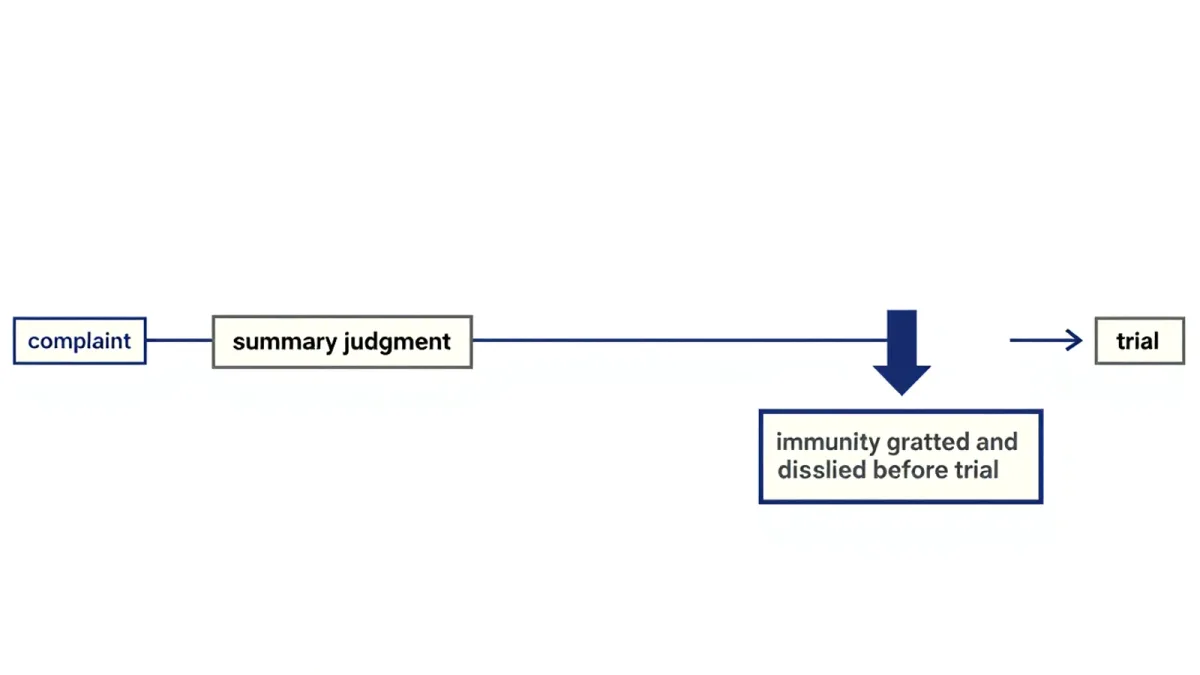
Critics across the ideological spectrum make two related arguments. First, the clear-establishment requirement is circular: if courts dismiss a case early without ruling on the merits, no precedent accumulates, so the next plaintiff cannot show the right was clearly established. Second, the Supreme Court has reversed lower courts that denied immunity, which some appellate judges have described as a pattern that discourages them from finding violations at all. Defenders answer that immunity protects split-second decisions by officers and guards public budgets from hindsight litigation, and that plaintiffs can still seek injunctive relief against officials who act prospectively. One procedural feature amplifies the stakes: under Mitchell v. Forsyth from 1985, a denial of qualified immunity is immediately appealable before trial, so the question often climbs to the court of appeals, and sometimes the Supreme Court, long before a jury ever tests the underlying facts.
What must a plaintiff show to get past it?
Surviving a qualified immunity motion requires two things at once: facts that, taken as true, describe a constitutional violation, and prior case law that clearly established the rule. Courts differ on which precedents count. Some circuits accept any relevant court of appeals or Supreme Court decision; others have at times demanded a controlling case with closely similar facts. That variance means identical conduct can survive a motion in one circuit and fail in another. Discovery also matters: officers frequently obtain stays that delay depositions until the immunity question is resolved, which is the litigation burden Harlow was designed to lift and its critics want narrowed.
Has Congress or the states changed anything?
Congress has not. The George Floyd Justice in Policing Act, which would have overridden qualified immunity by statute, passed the House in 2020 and again in 2021 but died in the Senate, and no successor has cleared both chambers. The Supreme Court has repeatedly declined certiorari on whether to reconsider the doctrine. States, however, can act directly, and several have:
- Colorado, in Senate Bill 20-217 of June 2020, created a statutory cause of action against officers and made qualified immunity unavailable as a defense to that state-law claim, with an indemnification scheme for agencies.
- New Mexico, in House Bill 4 of 2021, enacted its own Civil Rights Act that bars qualified immunity for claims under state law.
- Connecticut, in 2015, limited the defense for claims under its state civil rights statute, one of the earliest such moves.
These statutes do not touch federal Section 1983 claims; they build a parallel state-law route that bypasses the federal doctrine.
What does this change for people and police departments?
The practical map as of mid-2026 is split. In most states, a plaintiff suing an officer over a shooting, a forceful arrest, or an unlawful search must still satisfy Harlow's clear-establishment test in federal court, and early dismissal remains common. In the handful of states with statutory overrides, the same conduct can now be litigated under state law without the immunity filter, shifting costs toward officers' insurers and municipalities. The doctrinal debate continues at the Supreme Court, but the operating rule for most of the country remains the one the Court wrote in 1982: show the officer a precedent that made the violation obvious, or the case may never reach a jury. For departments, the policy consequence is quieter but real — where the immunity filter stays, liability costs shift to settlements and insurance; where states have stripped it, use-of-force training now has a direct dollar signal.