A security guard is a private employee whose legal authority comes from two places: state law and the property owner's rules. A guard is not a police officer. That single distinction answers most of the question of what can a security guard legally do — and what happens when a guard oversteps is usually a civil or criminal matter against the guard and the employer, not an official act.
The practical picture is narrower than the uniform suggests. Guards can observe, report, ask questions, and ask someone to leave private property. They generally cannot arrest in the police sense, cannot search a person or a bag without consent, and cannot use force except to defend themselves or others, or in limited cases to hold someone for police. The details shift from state to state, which is why this explainer stays general and points to the rules that actually govern.
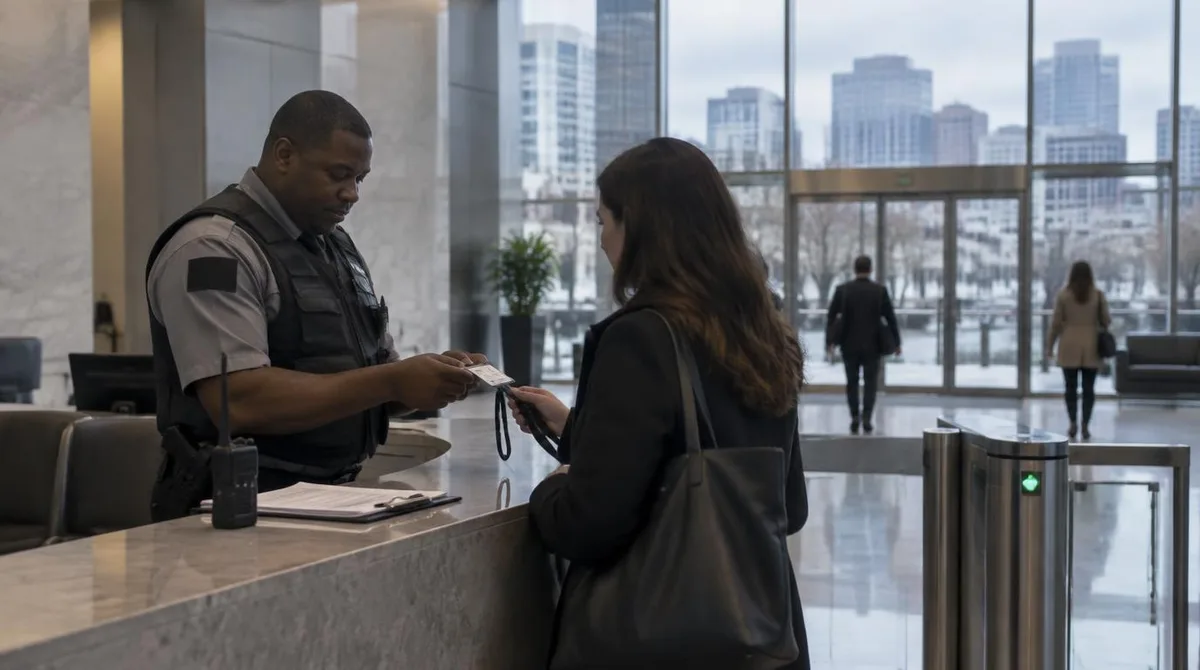
The industry itself draws the line between private guarding and public response clearly. Large contract firms describe their work as on-site guarding, mobile patrols, access control, alarm response and remote monitoring — Securitas lists services in Northern Virginia that run from reception and badging to fire-safety support and emergency escorts. None of that is law enforcement. It is presence, observation and delay until police arrive.
Where does a guard's authority actually come from?
It comes from property rights, not a government commission. On private property, the owner sets the conditions of entry. A guard acts as the owner's agent: the same right that lets a shopkeeper refuse service lets the shop's guard tell a trespasser to leave. On public streets, that authority shrinks to roughly what any private citizen has.
States license guards and set training requirements, and those rules matter. A licensed guard who follows state rules has a defensible legal position. An unlicensed or poorly trained one does not, and courts treat the employer as responsible for what its guards do on the job.
For readers tracking how government power is limited in adjacent ways, the contrast with military authority is instructive: What the Posse Comitatus Act Does and Doesn't Prohibit covers why federal troops generally cannot do civilian policing. Private guards face the mirror-image limit — they can do some things police need warrants for, but they lack the coercive powers police carry.
Can a security guard arrest or detain you?
Guards generally have no arrest power in the police sense. What exists in many states is the old common-law idea of citizen's arrest: a private person may, in defined situations, hold someone who has committed a felony in their presence, or in some states a shoplifting offense on the property. The rules vary sharply by state, and several states have restricted or reshaped the doctrine in recent years.
Detention is the riskier area for guards. Holding someone against their will can amount to false imprisonment — a civil claim, and in some circumstances a criminal one. Retail guards are usually trained to detain only on direct observation of a theft, to use minimal force, and to call police quickly. A guard who detains on a hunch, or holds someone longer than needed to reach the police, exposes the guard and the employer to liability.
The honest summary: a guard can stop you briefly in a narrow set of circumstances, the safest of which is a witnessed theft on the property they protect. Anything beyond that is a legal gamble the guard's company usually discourages.
Can a guard search you or your bag?
Not without consent, with one practical exception. Guards have no search authority. They cannot pat you down, open your bag, or go through your car because they are suspicious. What they can do is condition entry: a private venue may require bag checks as a rule of admission, and choosing to enter means choosing to consent. Courts generally treat that as voluntary, because you can walk away.
This is where the private-public divide shows its odd shape. A police officer usually needs suspicion and often a warrant. A private guard needs only the owner's rule and your agreement. But the guard's power ends at your refusal — at which point the guard's remedy is denial of entry or a request to leave, not a search.
When can a guard use force?
Force is lawful only in narrow lanes: self-defense, defense of others, and in some states protecting property or making a permitted detention. Even then, the force must be proportionate. Deadly force is lawful only where a private person could lawfully use it — which in most states means an immediate threat of death or serious injury, not a fleeing shoplifter.
Guard training reflects this. Contract firms emphasize de-escalation and documentation; Sunstates Security describes site-specific training and hands-on management support as the core of its Virginia operations, which is the industry's way of saying the guard on post should know exactly what the client's rules permit before anything happens.
What this means for the public is simple. If a guard uses force outside those lanes, the encounter becomes a false imprisonment or battery claim, and the employer's insurance and lawyers get involved. Guards know this. Well-run post orders are written to keep them inside the lines.
What should you actually do in an encounter?
Our analysis of the legal lanes points to a few practical steps that hold in nearly every state.
- Comply with reasonable requests on private property. If a guard asks you to leave, leaving is the low-risk move. Arguing the trespass on the spot rarely helps anyone.
- You may decline a search. A guard who insists anyway is creating a legal problem for the employer, not gaining authority.
- Ask if you are being detained. If the answer is no, you are free to walk. If the answer is yes, ask on what basis and whether police have been called.
- Document afterward, not during. Names, times, witnesses. If force was used or you were held, that record is what a lawyer or the state licensing board will want.
One caution belongs here: this article is general information, not legal advice, and state law controls the details. Anyone facing a real dispute should consult a lawyer licensed in the state where it happened.
The bigger picture: private security is everywhere, and lightly understood
Contract guarding has become a standing feature of American public space — campuses, hospitals, ports, distribution centers. Firms market the full stack now; Securitas's Chantilly operation advertises remote alarm verification, video surveillance and weapons-detection systems alongside human patrols. The technology expands what guards can see. It does not expand what they may do.
That gap — more capability, same legal limits — is where most disputes now start. A guard watching a camera feed still needs consent to search, observation to detain, and proportionality to use force. Readers interested in the public side of the same problem can follow how federal money shapes local protection in How DHS Security Grants Reach Cities, and the broader oversight questions in the site's rights coverage.
The evidence supports a plain conclusion. A security guard's lawful power is real but bounded: property rules, citizen's arrest where it survives, defense of self and others, and nothing more. The uniform signals responsibility, not authority. Knowing the boundary is useful for the public — and it is the first thing every properly trained guard learns too.