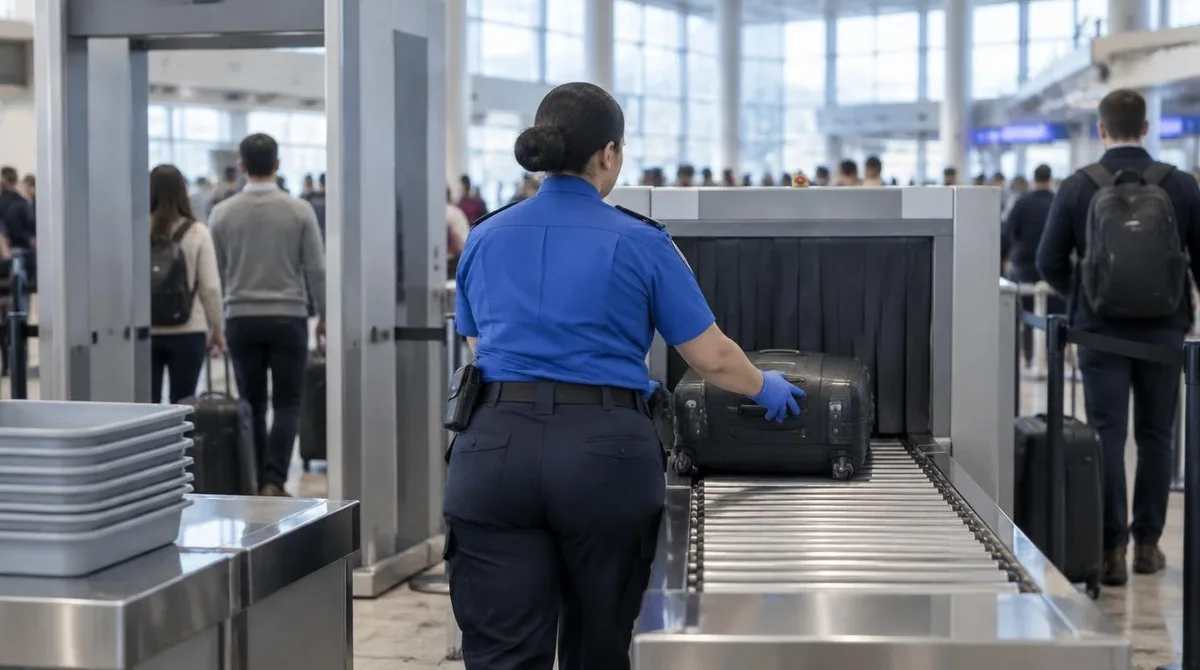
How does airport security work? In short: as a series of layers, not a single checkpoint. Identity, intelligence, technology and human judgment each do part of the job, and most of that work happens before a traveler ever reaches the metal detector or body scanner.
The visible line at the terminal is only the most public layer. Behind it sit watchlist checks, behavior observation, canine teams, baggage handling systems and a chain of human decisions about who and what gets a closer look. The word "behind" itself carries that sense of hidden work; even a Thesaurus.com entry lists senses ranging from physical position to concealment, which is roughly how the system is organized too.
This explainer walks through those layers in the order a traveler meets them, and notes where the public record ends and where the system deliberately stays quiet. It is analysis of how the machinery is generally understood to operate, not a description of any specific airport's procedures on any given day.
What happens before you reach the checkpoint?
Screening begins with data, not with luggage. Passenger name record information flows to government screening systems when a ticket is booked, and names are checked against watchlists and no-fly lists maintained by federal agencies. A traveler who clears this layer usually never knows it happened; a traveler who triggers it may face extra questions, a delayed boarding pass, or in rare cases a denial of transport.
This pre-checkpoint layer is the least visible and the least discussed. It is also the one with the most direct civil-liberties stakes, because it can restrict movement before any officer has seen the person. Coverage of how federal security decisions reach cities, including funding for local protective measures, appears in our How DHS Security Grants Reach Cities explainer.
Airport police and private security staff add another early layer. Their legal authority is narrower than many travelers assume, and differs from the authority of federal screening officers. Our separate piece on What Security Guards Can and Can't Do Legally covers where that line sits.
What does the checkpoint itself actually screen for?
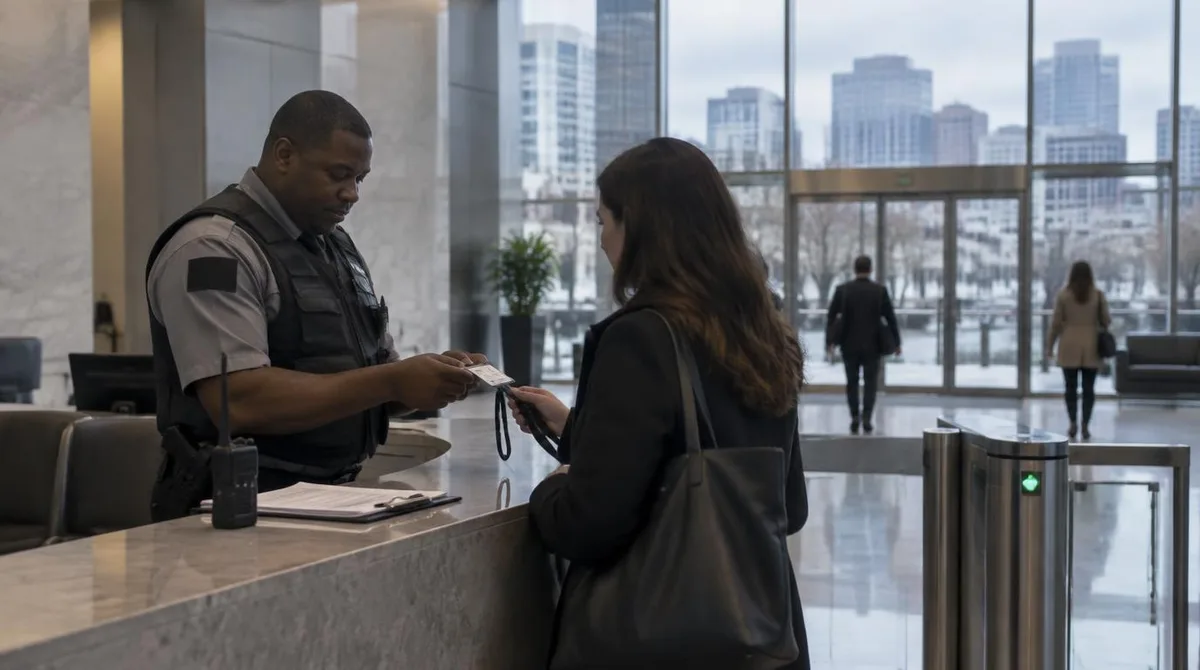
The checkpoint has one job: confirm that the person presenting at the lane is the person on the boarding pass, and that neither the person nor their carry-on items present a prohibited threat. It does this with a standard sequence: identity and boarding document check, property screening by X-ray, personal screening by a walk-through metal detector or a body imaging scanner, and targeted bag checks.
The X-ray operator is not looking for one thing. Explosives, firearms components, oversized tools, liquids beyond permitted limits and dense objects that obscure the image all draw attention. Modern systems color-code materials by density and can slice the image into views, letting an operator rotate a suspicious item on screen without touching the bag.
Body scanners use millimeter-wave imaging, which detects shapes and materials on or under clothing rather than metal alone. Automated detection software flags areas of concern on a simplified figure, and an officer resolves any flag with a pat-down. Travelers can generally opt for an alternative screening method in place of the scanner, though that choice almost always means additional hands-on screening.
Why do some travelers get pulled aside?
A secondary inspection is not an accusation. It usually means one layer flagged something the next layer must resolve: an unidentifiable shape in a bag, a scanner anomaly, random selection, or a document mismatch. Officers are trained to resolve flags rather than to assume guilt, and most secondary checks end with the traveler walking on.
Behavior detection is the most debated layer here. Programs that train officers to spot indicators of stress or deception have drawn criticism from oversight bodies and researchers who question their predictive value. The honest summary of the public record: the programs exist, their effectiveness is contested, and they are one input among many rather than a decision by themselves.
Canine teams work a different problem. Dogs are deployed at terminal entrances, queue areas and baggage halls, and a dog alerting near a traveler typically triggers a hand search or a swipe test for explosive residue. The dogs screen the environment, not the person, which is why an alert near you does not mean you personally are suspected of anything.
Who makes the calls, and under what rules?
Checkpoint screening in the United States is run by the Transportation Security Administration, an agency within the Department of Homeland Security, under federal regulations that specify what must be screened and how. Some airports use contracted private companies under a federal opt-out program, but those companies work to the same federal standards and remain overseen by the agency.
The rules behind the counter change more often than travelers notice. Prohibited-items lists, liquid limits and scanner procedures are adjusted over time, which is why the same item may pass in one year and be confiscated the next. The governing logic is risk-based: procedures tighten around threats of current concern and relax where a layer of the system is judged to cover the risk adequately.
That logic also explains the trusted-traveler programs. Pre-screened, background-checked passengers move through lighter physical screening, which concentrates officer time and technology on the unknown. The trade-off, and it is a real one, is that the system's accuracy now depends partly on how well it maintains those background checks over years.
What this means for travelers
Our analysis: the system works because no single layer has to be perfect. Watchlists, document checks, imaging, X-ray, canines, behavior programs and random selection each cover gaps the others leave. That design also means a traveler's experience is mostly determined by which layer happens to flag them, not by anything they did wrong.
Three practical takeaways follow from the structure itself. First, most delays at the checkpoint come from items that need a second look, not from people, so packing a bag with nothing ambiguous is the single most effective thing a traveler controls. Second, opting out of a scanner is a right in most cases, but it routes you to the manual layer, which is slower by design. Third, officers at the checkpoint have discretion within written procedures; arguing about the procedure at the lane rarely changes it, while filing a complaint afterward does enter a record.
What remains unknown is deliberate. The exact thresholds that trigger enhanced screening, the current watchlist matching criteria and the staffing behind each layer are not published, and for security reasons cannot be. The honest picture is a system whose visible half is well documented and whose invisible half is designed never to be. For more of our coverage of federal security machinery, see the Security section, and for the budget side of how these systems are funded, our policy desk follows the appropriations process in detail.