The national debt shows up in headlines almost every day, usually as a number too big to picture. But the debt is not a mystery. It is a running total of what the federal government owes, and it has known owners: people, companies, banks, government programs, and foreign countries. Once you see who holds the debt, the whole debate gets easier to follow.
Here is what the national debt is, how it grows, and who actually owns it.
What the National Debt Is
The national debt is the total amount owed by the federal government to the holders of its Treasury securities, according to Wikipedia's article on the national debt of the United States. At any moment, it equals the face value of all outstanding Treasury bills, notes, and bonds. These are issued by the Treasury Department and federal agencies. The debt does not generally include future promises, such as benefits that have not come due yet.
The debt grows through deficits. When the government spends more than it takes in through taxes, the gap is called a deficit, and borrowing fills it. The debt is the running total of those borrowed amounts. Congress caps the total through the debt limit, the same article notes.
The Two Big Buckets
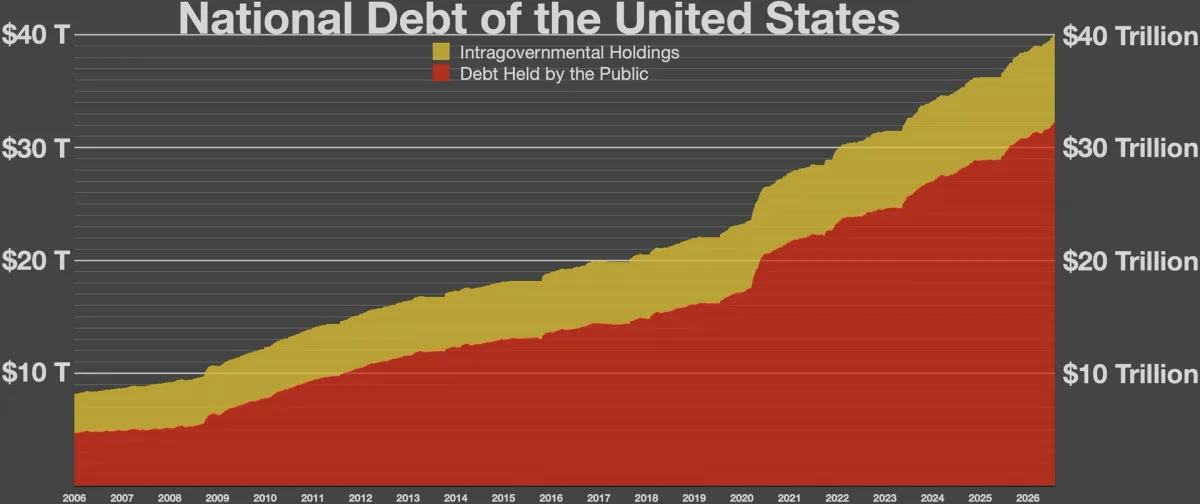
The debt splits into two main parts. The first is debt held by the public. That is money owed to investors outside the federal government, including individuals, companies, the Federal Reserve, and foreign, state, and local governments, according to the article. The second part is intragovernmental debt. That is debt the government owes to its own programs, such as the Social Security Trust Fund, which holds special Treasury securities in its accounts. We covered a connected angle in New Order Tightens Pentagon Rules on Foreign Critical Materials.
The split matters for the answer to "who owns it." A little less than half of the total national debt is owed to the Federal Reserve and intragovernmental accounts, according to the same article. In plain terms, a huge share of the debt is money one part of the government owes to another part.
Foreign Holders of the Debt
Foreign investors and governments own a large slice too. As of December 2020, foreigners held 33 percent of publicly held US debt, about $7 trillion out of $21.6 trillion, according to the article. Of that amount, $4.1 trillion belonged to foreign governments and $2.8 trillion to foreign investors.
The largest foreign holders are well known names. As of December 2020, the top three holders of American public debt were Japan, China, and the United Kingdom, according to the same source. Japan held $1.2 trillion, China held $1.1 trillion, and the United Kingdom held $0.4 trillion. Foreign ownership has moved over time. It grew from 13 percent of the public debt in 1988 to 34 percent in 2015, the article states. In recent years it has pulled back, in share and in dollars.
Why the Debt Keeps Climbing
The debt rises and falls with the budget. It typically grows when spending goes up and shrinks when tax receipts run strong, according to the article. History shows a pattern too. The debt-to-GDP ratio has tended to jump during wars, pandemics, and recessions, and then ease afterward. Because deficits keep being financed with new borrowing, the total has climbed over the long run.
For now, the scale is simple to state. The national debt exceeds the total annual output of the US economy, according to the same article. That is why the number gets so much attention from economists and lawmakers.
Conclusion
The national debt is not owed to a faceless void. It is held by two big groups. One is the government itself, including the Federal Reserve and program trust funds. The other is the public, which includes American investors and foreign lenders such as Japan and China. The total grows when deficits add new borrowing, and its size shifts with wars, recessions, and recoveries. Knowing the owners changes the debate. Paying interest on the debt sends money to those holders, and policy choices decide how much new debt gets issued. The debt is complex, but its owners are not a secret, and the government publishes the total every day. For related coverage, see How Congress Kills a Federal Rule Without Writing New Law.