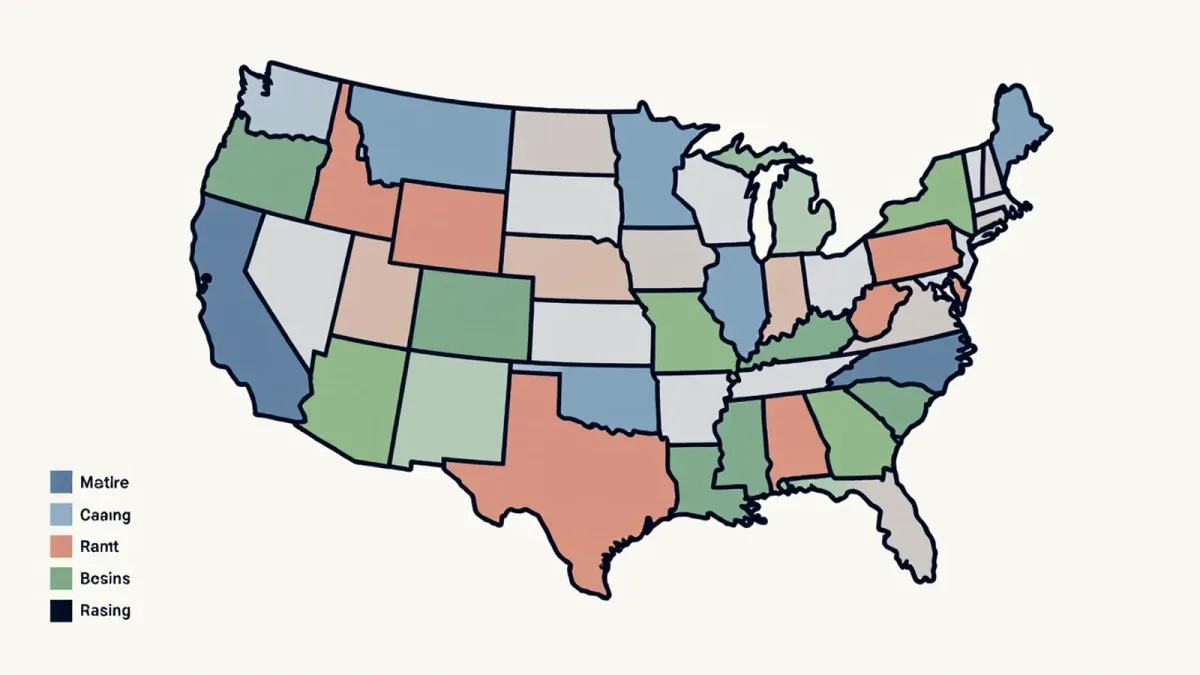
Voter ID requirements in the United States fall into four working categories — strict photo, non-strict photo, strict non-photo, and non-strict non-photo — and as of 2025 roughly three dozen states had laws requesting or requiring voters to show identification at the polls, per the National Conference of State Legislatures' running tally. The category a state lands in decides one thing: what happens if a voter arrives without the required document. The document lists themselves — which IDs count, and which alternatives — are set state by state.
What are the four categories?
The classification turns on two axes: whether the ID must include a photograph, and whether a voter without it has an alternative to casting a regular ballot on the spot.
- Strict photo ID. A voter without an approved photo ID must cast a provisional ballot or an equivalent backup, and that backup counts only if the voter takes a follow-up step, such as appearing at the election office within a set window. States in this group include Georgia, Indiana, Kansas, Mississippi, New Hampshire, South Carolina, Tennessee, Virginia, Wisconsin, and Arkansas, among others.
- Non-strict photo ID. Photo identification is requested and may be required, but a voter who lacks it can still cast a regular ballot after signing an affidavit or where an election official can vouch for identity. Texas operates this way: a voter without an approved photo ID signs a reasonable-impediment declaration and may present alternatives such as a utility bill.
- Strict non-photo ID. Identification is mandatory but photographs are not; documents like a utility bill, bank statement, paycheck, or government document showing name and address qualify. In practice several states in this column rarely leave voters without options because the accepted list is broad.
- Non-strict non-photo ID. Election officials may ask for any form of identification, but lacking it does not block a regular ballot — an affidavit, a signature match, or a poll worker's attestation suffices.
The remaining states have no documentary ID requirement at the polls; voters verify identity by name and signature, and California, New York, Illinois, and Pennsylvania are prominent examples. elections coverage.
Which documents do states actually accept?
Lists narrow quickly. Commonly accepted photo IDs include a driver's license or state ID card, a U.S. passport, a military ID, a tribal ID, and an ID issued by a state election authority — some states, such as Indiana and Wisconsin, issue free voter ID cards precisely to satisfy their own requirement. Beyond that core, acceptance varies sharply:
- Student IDs are accepted in some states but excluded or restricted in others, and several states accept only public-college IDs or require an expiration date within a set period.
- Concealed-carry permits count as voter ID in a handful of states, including Texas and Tennessee, while neighboring states reject them.
- Expired IDs split by state: some accept any expiration, others require expiry after the most recent election.
- Tribal identification is accepted in states with significant tribal populations, including Arizona, New Mexico, and North Dakota, which has no registration system and relies heavily on ID at the polls.
What does federal law require anyway?
One narrow rule, and it applies everywhere. The Help America Vote Act of 2002 requires voters who registered by mail and have not voted federally before in that jurisdiction to show ID — a current photo ID or a non-photo document showing name and address, such as a utility bill, bank statement, government check, paycheck, or other government document. Codified at 52 U.S.C. Section 21083, the rule affects first-time federal voters rather than the electorate at large, which is why a first-time registrant may be asked for ID even in states with no general ID law. Every state must also offer provisional ballots under HAVA, and those ballots interact with ID rules: in strict-ID states a voter turned away for lack of ID typically casts one.
How do provisional ballots resolve an ID problem?
Through a cure window with a deadline. In strict-ID states, a voter without acceptable ID casts a provisional ballot and must then take a follow-up step — presenting qualifying ID to the county or state election office in person, or in some states submitting a copy — by a fixed date after the election. Miss the window and the ballot does not count; meet it and the ballot counts with the rest. New Hampshire, for example, lets a voter without photo ID complete an affidavit and return with verification to the secretary of state's office after the election. The practical consequence is that strictness lives less in the polling place than in the days that follow it, when a voter either supplies the document or does not.
How did the map get this way?
Through two decades of state legislation after a federal template. Indiana passed the first strict photo ID law in 2005, and the Supreme Court upheld it against a facial constitutional challenge in Crawford v. Marion County in 2008, finding the burden on most voters slight while noting plaintiffs could still prove an undue burden in a specific case. That decision cleared the field: state after state adopted ID laws of varying strictness through the 2010s, each calibrated to its own politics and courts. The map is not static. Legislatures tighten or loosen requirements in ordinary sessions — a state can move from non-strict to strict, expand or cut its accepted-documents list, or add a free voter ID program — and ballot measures sometimes decide the question directly. The durable lesson from Crawford is that litigation attacks specific burdens rather than the category itself, so the practical details, not the label, are where legal fights land.
What does this change for voters?
Plan around the document list, not the headline rule. A valid driver's license works nearly everywhere ID is required, which is why most voters never notice the differences between states. The friction concentrates on specific groups: first-time voters, recent movers whose ID shows an old address — some states require the address to be current, others only the name — students, and voters whose documents were lost or expired. Election offices in strict states generally issue free voter ID cards with a birth certificate or equivalent proof, but that step takes a trip and a lead time. Check the secretary of state's accepted-documents list before election day; it is the authoritative text, and it changes more often than the underlying statute.