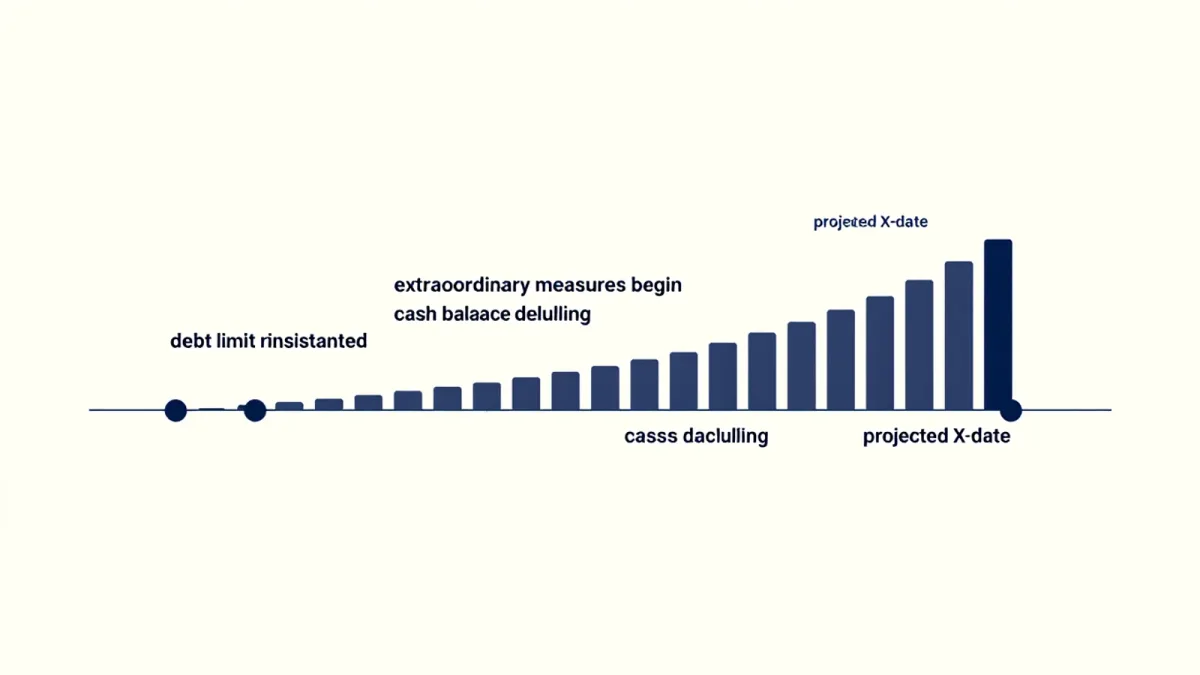
The debt limit is a statutory cap on total Treasury borrowing to pay obligations Congress has already authorized, and the X-date is the estimated day cash and accounting maneuvers run out and bills go unpaid. After the cap's 2023 suspension expired, the limit was reinstated on January 2, 2025, at roughly $36.1 trillion — the debt outstanding that day.
The United States is unusual among large economies in requiring a separate vote to authorize debt issuance at all. The limit dates to the Second Liberty Bond Act of 1917, which let Treasury borrow without per-bond legislation but inside a ceiling. Congress has since raised, amended, or suspended the limit more than 100 times. The mechanism does not authorize new spending; it authorizes financing for spending laws already on the books. Defaulting on it has never happened, but coming close has become routine, and each episode turns on the same two questions: how much cash Treasury holds, and when the X-date falls. This publication reports on the machinery, not as financial advice.
What exactly does the debt limit restrict?
It restricts gross federal debt — nearly all debt issued by Treasury, including securities held in government trust funds such as Social Security's. When the limit binds, Treasury cannot issue new debt to cover deficits or maturing securities, even though tax revenue keeps arriving. Daily federal outlays run in the tens of billions of dollars against tax receipts that arrive unevenly through the year, so Treasury's operating balance — the Treasury General Account, published every business day — is the first number analysts watch. A suspended limit, as in 2019-2021 and again in 2023-2025, removes the cap until a preset date, after which debt returns at whatever level has accrued, with no vote needed for the reset itself.
What are extraordinary measures?
Extraordinary measures are accounting maneuvers, authorized by Congress in advance, that create temporary headroom under the limit. The best known is the G-fund maneuver: Treasury suspends new investment of the Government Securities Investment Fund held in federal employees' retirement accounts and disinvests portions of it, freeing room to issue debt elsewhere without breaching the cap. Treasury also suspends new investments in the Exchange Stabilization Fund and declares a debt issuance suspension period for certain securities. None of these touch benefit payments — they reshuffle intragovernmental accounting — and each is reversible once the limit is raised, with the trust funds made whole. Their capacity is finite, generally in the low hundreds of billions of dollars, which buys weeks to months. The 2025 episode illustrated the arithmetic: extraordinary measures opened in January and carried Treasury into the summer, when Congress raised the limit by $5 trillion in the July reconciliation law, per Treasury statements, before the projected fall X-date arrived.
How is the X-date actually estimated?
By building a daily cash forecast: projected tax receipts, projected outlays, and the volume of securities maturing and needing refinancing, measured against the headroom extraordinary measures provide. The Congressional Budget Office publishes such estimates each time the limit binds, with explicit uncertainty bands — its 2023 analysis, for example, gave a range rather than a single day because receipt and outlay timing varies. The Bipartisan Policy Center has run parallel estimates for years and coined much of the modern vocabulary around the deadline. Collections season matters: a X-date in April, when tax receipts peak, lands differently than one in the low-collection late-summer months. Those maneuvers bought Washington roughly half a year in 2025 before Congress raised the limit by $5 trillion that July, per Treasury statements. Treasury's own accounting is precise about cash but deliberately spare about the X-date; outside estimates fill the calendar.
What happens if the X-date passes without action?
Treasury would face obligations it cannot pay in full on time. Officials and analysts across administrations have warned of severe consequences: missed or delayed payments to bondholders, federal employees, or contractors; a spike in borrowing costs; and stress in money markets that price Treasury bills as the world's risk-free collateral. The 2011 standoff did not produce default, but S&P downgraded the United States' long-term credit rating for the first time, and Treasury later reported that the episode's uncertainty raised federal borrowing costs. What Treasury would prioritize in a true impasse — bondholders over vendors, defense pay over domestic programs — has been debated in every episode and never tested, because no administration has wanted to publish a triage plan it might have to execute.
What are the standing proposals for changing it?
The recurring menu has four items. Raise the limit by a fixed amount, the traditional approach. Suspend it for a period, used in 2013, 2019, and 2023, which defers the next deadline. Tie future increases to other legislation, the pattern of recent episodes, including the 2023 Fiscal Responsibility Act's spending caps and rescissions. Or eliminate the limit and let debt follow appropriations automatically — a proposal that has surfaced in testimony repeatedly, on the argument that the limit adds default risk to decisions already made. Defenders of the status quo answer that the limit is one of the few remaining leverage points for fiscal restraint in a divided government, which is precisely why it keeps being used as one.
Why the X-date, not the deadline date, drives everything?
Because markets and negotiators respond to the projected day of insolvency, not the legal cap date. Once extraordinary measures begin, the political and market calendar re-anchors on estimates — CBO's, think-tank models', Treasury's silence — and every revenue surprise moves it. Every estimate is a probability band, and every weekly Treasury statement nudges the band. The practical watch list is short: Treasury's daily statements showing extraordinary measures in use, the Treasury General Account balance, CBO and outside X-date analyses, and the debt issuance calendar. History's lesson since 2011 is that resolution tends to arrive at the last minute — the 2023 standoff ended two days before the Treasury Secretary's stated early-June deadline — but late enough, each time, to exact a measurable price in yields and credibility.