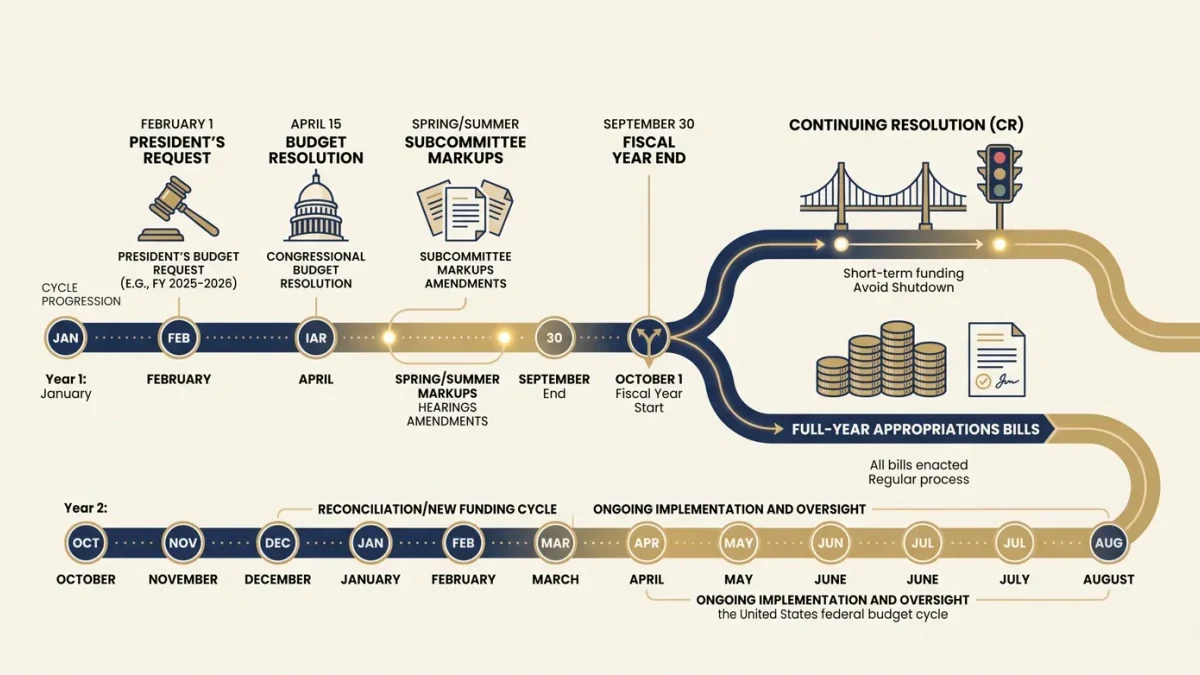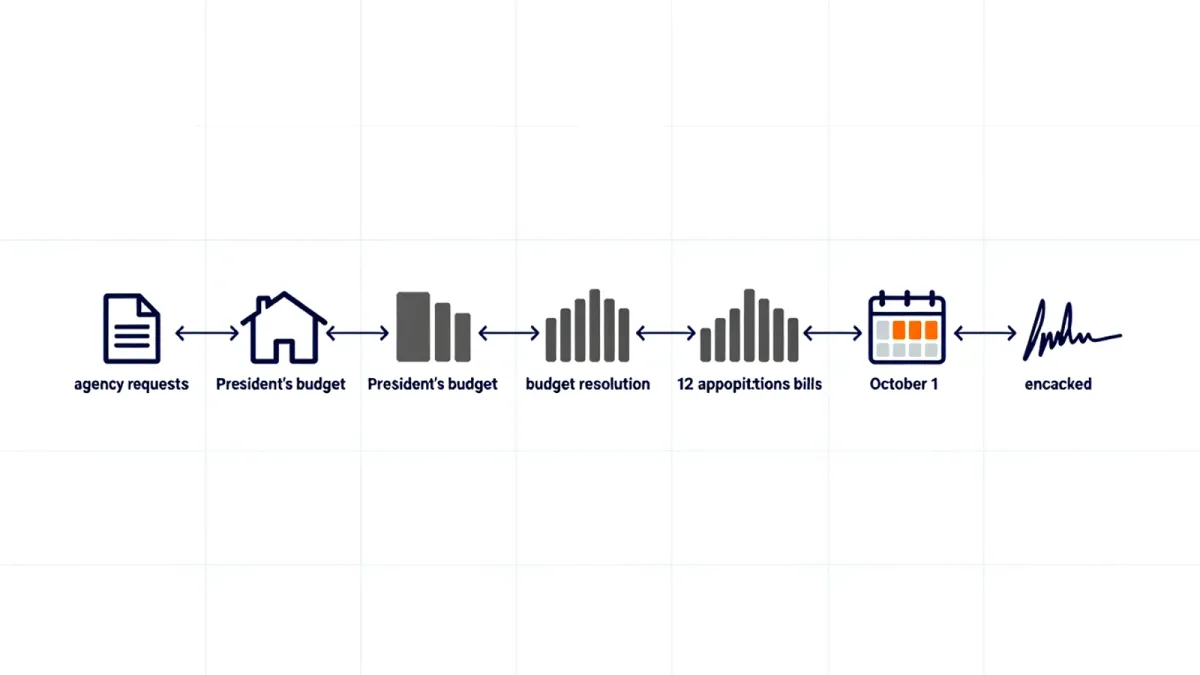
A federal agency's budget justification is the volume submitted to Congress alongside the president's budget — due the first Monday in February under 31 U.S.C. 1105 — explaining appropriation by appropriation what each request funds. The Pentagon's version runs to thousands of pages, which is why the document's fixed anatomy matters more than cover-to-cover reading.
The president's budget gets the headlines, but the justification books are the working documents of the appropriations process. Agency officials carry them to hearings, appropriators mark them up line by line, and the language that survives them often migrates verbatim into committee reports and bill text. For a reporter, an oversight staffer, or a contractor trying to see where the money goes, the justification is the most granular public account of an agency's priorities — more detailed than the budget's summary volumes and more explanatory than the apportionments the Office of Management and Budget issues afterward. The book is a bureaucratic genre with conventions, and the conventions are the reading guide.
What does a justification volume actually contain?
Most civilian agencies follow a recognizable template, and the Defense Department's structure is similar in spirit. Expect, in rough order: an overview chapter stating the agency's mission and top priorities; an organizational chart mapping request to bureau or office; a summary table showing the request by appropriation account against the prior two enacted years; appropriations language — the legal text the agency wants Congress to enact, with proposed changes marked; and then the heart of the document, the justification of each account, typically organized by activity or program, with tables decomposing each line into personnel, operations, contracts, grants, and construction. Civilian volumes also carry performance chapters tied to the agency's strategic plan, as the Government Performance and Results Act requires.
Where are the numbers that matter?
Three tables carry most of the weight. The account-level summary, usually an "Overview" or "Summary of Requirements" table, shows the topline by appropriation and the change from the enacted year — the fastest read on shifting priorities. The object-class breakdown, a standard exhibit required by OMB Circular A-11, splits each account into personnel compensation, benefits, contractual services, grants, and supplies, revealing whether growth is hiring or outsourcing. The full-time equivalents table shows requested staffing against current levels. Comparing those across two successive justification books — both remain on agency budget sites — exposes what changed: a program line that grows while its justification text stays static is a line worth questions, because the money moved faster than the explanation. That mismatch between narrative and table is the single most productive place to start reading.
What are the tells of a real priority change?
Read the appropriations language changes first. Proposed revisions to legal authority — a new transfer authority, a reorganized account structure, a modified ceiling — signal structural change more than a percentage increase does. Second, read the budget activities that appear and disappear: a renamed budget activity usually marks a reorganization or a repackaged initiative, and prior-year comparability tables exist precisely so readers can trace the continuity. Third, read the outyear projections: a one-year bump that returns to baseline in the outyears is a project; a request that steps up across the five-year projection is a program. And fourth, read the hearing record against the book — members' questions and the agency's written responses, called questions for the record, frequently surface the details the justification itself smoothed over.
How does the document relate to the actual appropriation?
Only the appropriations language Congress enacts is binding; the justification's program-level tables are requests, not commitments. Congress routinely funds accounts at levels different from the request and directs changes in committee report language, which the justification never contains. After enactment, the OMB apportions the money to the agency in allotments, which can further shape how it is spent. The practical rule: the justification shows what the agency wants, the committee report shows what Congress was told, the enacted bill shows what it got, and the agency's spend plan shows what actually happened. Following one program across all four documents is the only way to see the full cycle. Timing matters as well: the justification reflects policy decided the previous autumn, so by the time hearings arrive the numbers may already trail the agency's own current thinking — which is why late-breaking initiative announcements in hearing testimony often come with no matching line in the book yet.
What are the document's known limits?
Three limits should temper any reading. First, aggregation: account and activity lines summarize many programs, and a cut hidden inside a growing line is invisible without prior-year tables. Second, presentation: agencies choose how to describe initiatives, and enthusiasm in the narrative is not proportioned to the money attached. Third, classification: for defense and intelligence accounts, unclassified volumes describe programs at a level of generality that masks real movements. Seasoned readers therefore rely on the tables over the prose, cross-check against GAO and CBO analyses of the same request, and treat the hearing transcript as the document's missing chapter.
Where do you find these documents?
Every major agency posts current and prior-year justification books on its budget or CFO section — the pattern across the departments of Defense, State, Justice, Health and Human Services, and the rest — and congressional staff compile them through the annual appropriations hearings. OMB Circular A-11 prescribes much of the required content and table formats, which is why the volumes look alike across administrations. For the previous year's enacted figures, the House and Senate Appropriations Committees' printed hearings and reports pair with the justifications. The documents are dense but public, unclassified in nearly all civilian cases, and updated once a year — a fixed annual dataset for tracking what the federal government says it is buying, request by request. For anyone building a longer series, the books reward that consistency: five years of justification volumes for a single agency read in sequence show reorganizations, priority drift, and the quiet birth of programs that never merited a press release.