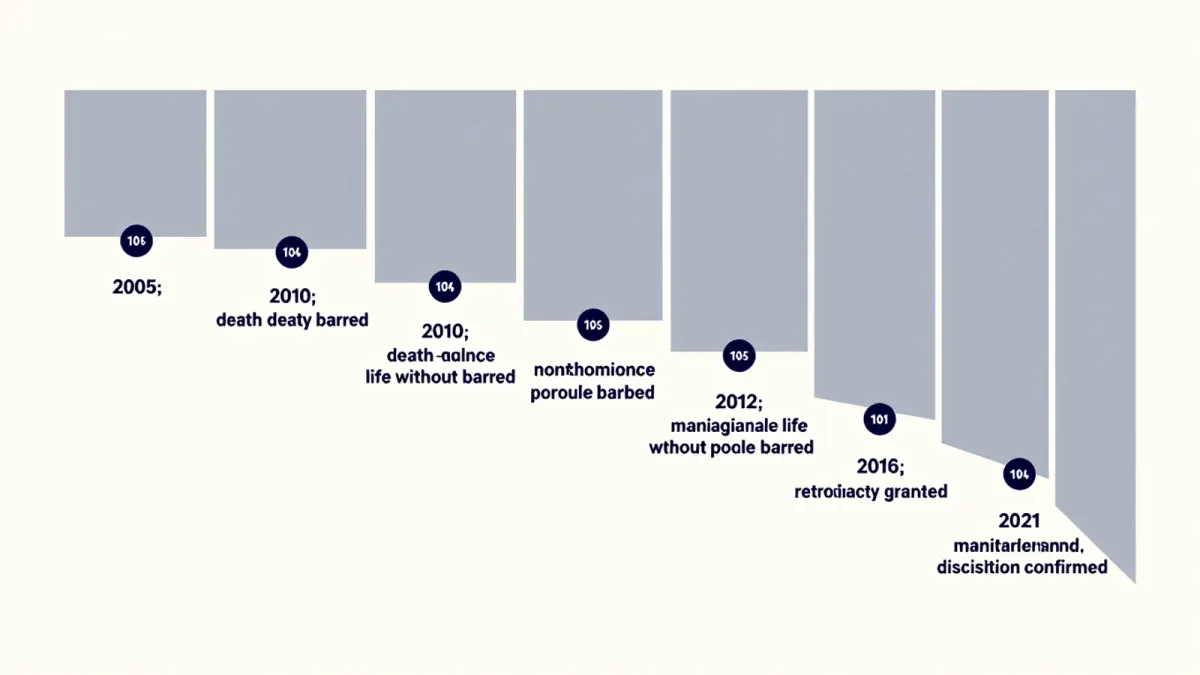
The constitutional rule on juvenile life sentences comes from three Supreme Court decisions: Miller v. Alabama in 2012 held that mandatory sentences of life without parole for offenders under 18 violate the Eighth Amendment; Montgomery v. Louisiana in 2016 made that rule retroactive, entitling roughly 2,000 sentenced inmates to new hearings; and Jones v. Mississippi in 2021 held that a judge may impose discretionary life without parole on a minor without a separate factual finding of permanent incorrigibility. The result: life without parole for juveniles is lawful in theory, but only as a deliberate individualized choice, and it is rarely the sentence imposed.
USA Daily News 24 is an online publication, not a law firm, and it publishes information, not legal advice. Anyone navigating a resentencing or a juvenile transfer should rely on counsel in the sentencing jurisdiction.
What did Miller actually decide?
Miller consolidated the cases of two 14-year-olds sentenced to mandatory life without parole under state statutes that left judges no choice after conviction. A 5-4 Court held that children are constitutionally different — less mature, more vulnerable to peer pressure, more capable of change — and that a mandatory life without parole scheme deprives the sentencing court of the chance to weigh those differences and the child's circumstances. The Court stopped short of banning the sentence outright: life without parole remains available for juveniles whose crimes reflect irreparable corruption, but only through individualized sentencing that considers youth and its hallmarks. The decision sat in a line with Roper v. Simmons in 2005, which barred capital punishment for minors, and Graham v. Florida in 2010, which barred life without parole for nonhomicide offenses.
What did Montgomery and Jones add?
Montgomery resolved the retroactivity question in 2016: the Court held 6-3 that Miller announced a substantive rule, so the roughly 2,000 prisoners serving mandatory juvenile life without parole sentences could seek relief in state courts, whatever their states' usual limits on reopening final convictions. Justice Anthony Kennedy's opinion framed the rule as one that categorically prevents a certain class from receiving a punishment no one may constitutionally impose. Jones then answered what happened next: in 2021, a 5-4 Court held that a sentencing judge may impose discretionary life without parole on a juvenile without first making a separate factual finding of permanent incorrigibility — the judge's denial of a defendant's request to find incorrigibility was enough to show the mandatory life sentence rested on individualized consideration. Justice Brett Kavanaugh wrote for the majority; Justice Sotomayor's dissent argued the ruling hollowed out Miller's promise.
Why does youth matter constitutionally?
The underlying science is cited by the Court itself in Roper: adolescents' brains, particularly the prefrontal regions governing impulse control and long-term judgment, continue developing into the early twenties. The decisions translate that into legal doctrine — diminished culpability for children, heightened prospects for rehabilitation, and therefore an Eighth Amendment principle that punishment must account for the difference. Whatever one thinks of the neuroscience, its legal effect is fixed: the cases rest on the categorical distinction between minors and adults, and Jones reaffirmed rather than weakened it. That foundation also explains why the doctrine has proven durable across changes in the Court's composition.
How have states responded?
State legislatures have done most of the recent work. Pennsylvania, which once held more juvenile lifers than any state, enacted resentencing legislation in 2019 after Montgomery; dozens of formerly mandatory sentences there have been converted to parole-eligible terms. States including California, Iowa, West Virginia, and Massachusetts have barred or effectively eliminated juvenile life without parole by statute or court decision. By the mid-2020s, per Sentencing Project analyses, well under half the states still permitted the sentence in any form, and imposition nationwide had fallen to a handful of new sentences a year — the practical measure of the doctrine's effect.
What happens in a resentencing hearing?
The Montgomery cohort enters court years after conviction, and the hearing centers on capacity for change: testimony about childhood trauma, brain development, conduct in prison, education, and family ties; expert evidence on adolescent development; and the sentencing judge's discretion to impose parole eligibility, a term of years, or in rare cases life without parole again. The defendant's conduct over decades in custody carries more weight than the original offense's circumstances, which is why these hearings function less like appeals and more like new trials on the question Montgomery itself posed — who, exactly, is irreparably corrupt? Outcomes vary widely by state and judge, and post-Jones, prosecutors in some states again argue for life sentences at these hearings with the incorrigibility finding folded into the argument rather than the verdict.
What happens at the parole stage after resentencing?
Resentencing to a parole-eligible term does not mean release; it means a hearing before a parole board that many of these defendants first face decades into custody. States differ on whether Montgomery resentences make parole presumptively available at a set fraction of the term or leave eligibility to the original sentence structure. Boards weigh institutional conduct, programming, and release plans, and research on the resentenced cohort — Pennsylvania's is the largest studied — has shown low reconviction rates among those released, evidence reform advocates cite and opponents rarely rebut. The parole stage, not the courtroom, is where the Montgomery promise is actually cashed out.
What does this change going forward?
The doctrinal floor as of mid-2026 is stable: no mandatory juvenile life without parole, retroactive relief for the original cohort, and a discretionary sentence that survives Jones but is used sparingly. The remaining fights are practical — how many of the Montgomery cohort have actually been resentenced, with pending litigation in a few slow-moving states; whether extreme term-of-years sentences, like 60- and 80-year terms, evade Graham's logic through arithmetic; and whether the trend toward abolition at the state level continues into the remaining permissive states. The three cases changed the question from whether children can receive a state's harshest sentence to whether any specific child deserves it — a shift in burden that has, in practice, been the whole story. A sentence that was once the statutory default for a 14-year-old murderer is now a rare, argued, individually justified exception, and every actor in the system — prosecutor, defender, judge, parole board — now plans around that default.